Three keys to a successful modern marketing plan

I assembled these notes in advance of a presentation I thought I would be giving.  That didn't come together but I did want to share these three points here as "keys to a successful modern marketing plan."  There are definitely more parts to a plan than what is listed here but I believe these are especially relevant to what you can do and must do given how technology has changed both the approach and pace of marketing.

1.  Launch is a process not an event

Launch is not a one time event for your company.  Launch is a continuous process whether it is the release of new features, a partner announcement, or just a continuous flow of information and events that you are driving. 

I am not a fan of the "one shot" launch events.  Not because I don't think Techcrunch 50 or Demo are good events.  I just believe there are way too many variables that impact a positive outcome…and that the results of the outcome are fleeting.  Isolating everything that could potentially derail a demo or conflicts that could lead to a sparse audience is pretty much impossible so don't set yourself up for disappointment. 

I recommend laying out your time line and finding the events that support it.  Do not spend buckets of money on events although many require some level of sponsorship to get on stage.  Just be frugal about spend and critical of the opportunity.  If it seems to good to be true or it is presented (sold) as the "make or break" event for your company, move on.

2.  Identify on-line influencers in your domain & meet them

Everyone can be a publisher these days and there are no shortage of bloggers, podcasters, and amateur journalists in just about every industry and sub-industry.  A bit of time using a search engine will reveal lots of targets for your given domain that have huge readerships.  Engage with these on-line influencers, share your expertise, and provide content for their audiences.  Traditional newspaper circulation continues to decline so focus on those who focus on what you do and in your space rather than hope for that big article in the Wall Street Journal.  If what you are doing and saying is compelling (and you are really are on expert), those opportunities will find you.

3.  Embrace new technologies but don’t lose sight of fundamentals

Social media is a tactic, not a profession.  It has a role in the marketing mix and is a phenomenal customer support tool.  See it for what it is and understand it is a platform for your brand.  Use channels like Twitter, Facebook, and your blog to share news about you, about your industry, and to show off your expertise as well as that of others (yes, including your competitors).

For a bit of additional perspective, watch this video about how the fundamentals of B2B marketing stay the same:

Social Overload

I am definitely beginning to suffer from this. 

I'm not talking about being social with people (old school social networking), I'm talking about all the ways I can "be social" while staring at my computer or my mobile device including all the activity streams coming from multiple sources across multiple accounts flowing in many directions.

I maintain accounts both personally and for work across a variety of networks including Twitter, Facebook, and LinkedIn and use a variety of tools to try to keep up (Tweetdeck, Google Reader, Echofon, Twitterberry, and a few others) with what is being said to me, about me, about my company, about competitors, and about interesting things related to the previous.  This doesn't even include the effort required to share relevant and valuable content back into this swarm of status updates, likes, and shares.  I currently have 343 feeds coming into Google Reader spanning various keyword and content alerts plus blogs that span messaging, collaboration, venture capital, start ups, marketing, capital markets, personal finance, and various towns and cities that I like to keep an eye on.  Oh, and don't forget about news outlets like The Wall Street Journal and CSPAN (yes, I really do follow CSPAN on Twitter).

And I won't even begin to bore you with the email volume in four different work and personal accounts.

The challenge is to actually listen to what is being said versus just talking and, more importantly, hear the important things and be conversational.

It may seem like a shameless pitch (I work there) to mention the value Gist currently delivers to me to make sense out of this massive flow of information.  It gives me the ability to get an update on people who are important to me, companies I am interested in, and all of the associated content, status updates, and related news. I don't even need to worry about not being hip to the latest trendy micro-messaging, sharing, friending thingy because if it is available as a public feed, Gist will find it and associate it with the right person. 

More great stuff is on the roadmap to address my social overload and it can't come too soon. 

What are good email marketing open and click rates?

I'm a fan of using email marketing as part of a broader marketing plan as long as it is not abused and functions as a platform to share information the recipient will find valuable as opposed to shameless product pitches. 

There are lots of different options here including self-service ones like VerticalResponse (which I currently use), Constant Contact, and MailChimp as well as ones like Portland-based eROI and Nashville, TN-based Emma which integrate agency services along with the email capability.  The full list of options is very long (including Atlanta-based Silverpop & Seattle neighbor WhatCounts) and I know I am not doing it justice here.

The purpose of this post is to dig into what are good results from an email marketing campaign.  How many opens, clicks, bounces, unsubscribes, etc. are actually good when compared to what is best in class?

I know what I have seen in my efforts and am happy to discuss one-on-one if you are interested.  Here is what I found after a few quick searches:

  • Great chart from the folks at MailChimp with a breakdown by industry (small businesses).  The average of the averages (sorry mathematicians) pegs this around a 25% open rate with just over a 4% click rate looking across some 273M sent emails. Unsubscribes are pretty low at .36% while hard bounces (not a valid email) seem high to me at almost 6%.  People change jobs and email addresses go stale but I have not seen a result this high or it could be due an extended interval between sends.

  • Good stats posted on eMarketer although pegging the high end of list size at 1000+ seems curious to me (my lists are always much larger than this and I hope yours are too)Their citation of a report by MailerMailer puts the "worldwide" open rate at 12.5% at the end of 2008.

I'm not sure I am leaving you with what is best in class but at least this can function as a frame of reference.  I am not an email marketing expert by any means but believe in it and its responsible use for any organization.

Blogging will change your life

Don't believe me?  Then listen to what Tom Peters and Seth Godin have to say about it.  Good friend Max Effgen at 12Sided posted this some time ago and I flagged it to share here.

It is short and captures the essence of why I started blogging and the fulfillment I get from doing it.  It forces you to more fully and thoroughly think through things, truly grasp why you believe the way you do, and structure those thoughts and beliefs for others to consume.  I write as much for myself as I do for others and am thankful to those of you who think my posts are worth reading and keep coming back for more.

Earn permission to respond

This is a great (and short) blog post by Seth Godin on the topic of being accessible and making it easy for people to initially contact you.  Think about the last time you wanted information or were looking to buy something.  Did you want to answer a bunch of questions or provide a lot of information about yourself?

Email contact is like a first date. If you show up with a clipboard and
a questionnaire, it's not going to go well, I'm afraid. The object is
to earn permission to respond.

Keep it simple.  Request an email address or make it easy for people to send you an email with some questions (and be sure to respond quickly!).  This is just the beginning of the discussion not the end.

Why Positioning Matters

Happy Labor Day everyone.  I thought a post on "positioning" was timely because not only is it something we are continuing to focus on and evolve at Gist but it also came up last week in one of my mentoring sessions as a NWEN Advisor.  Also, it is no small effort to get right so thought it appropriate to discuss on Labor Day.

What is positioning and why is it important (according to me)?

The positioning strategy is a competitively focused statement of what makes a company different and better than the competition.  It is a description of how prospective customers, partners, etc. should think of the company relative to the competition.  A fundamental of good positioning strategy is creating perceived differentiation in an area that is important and relevant to those audiences.  Since positions are “relative to the competition,” it is important to understand how competitors are currently perceived and how they are trying to position themselves.

How do I come up with it (not sure where I got this from originally, so apologies for no source reference)?

[Company Name] provides  [product or service category]
For [your beachhead target customer]
So they can  [product’s primary benefit].
Unlike [the product alternative]
We [key differentiator]

This is definitely an exercise about picking the right words but in order to pick the right ones you must understand the broader landscape and how companies operate within it.  In an early stage company this is not a one time effort that you complete and move on.  It is a constant and iterative process as you learn more about your customers and market and the difference between how you want to be perceived and are perceived becomes clear.

Marketing Mayhem

Over the past year plus, I have been working with a whole new set of tools to understand and reach customers/prospects/users.  This includes Twitter, Linkedin, Facebook, blogs, blog comments and the associated technology to access and analyze what is being said and who is saying it.

Unlike mainstream marketing thinking, what I have been doing has cost very little money and utilizes new tools to reach people in the new places they are spending their time.  More importantly, the leverage in selling resides disproportionately with the buyer these days.  They have instant access to information about you, your competitors, and even the ability to connect with your current and former customers all without your help or involvement.  Understand this is reality and embrace it.

So, what should you do if you are trying to sell something, launch something new, or just expand market share within existing target market?  Set up and make use of a Listening & Engagement Framework.  Check out my previous posts on it to understand what the heck I am talking about.

I have been making extensive use of this type of framework at Gist and put together the presentation embedded here to highlight both what we have been doing as well as the thinking and assumptions behind it all.  Check it out and let me know thoughts and feedback.  One thing I have learned is that the rules are still being written and best practices emerge daily on the best way to use all this stuff as a business.

Building an engagement framework

Apologies again for the slow posting recently.  Life and work got in the way a bit…

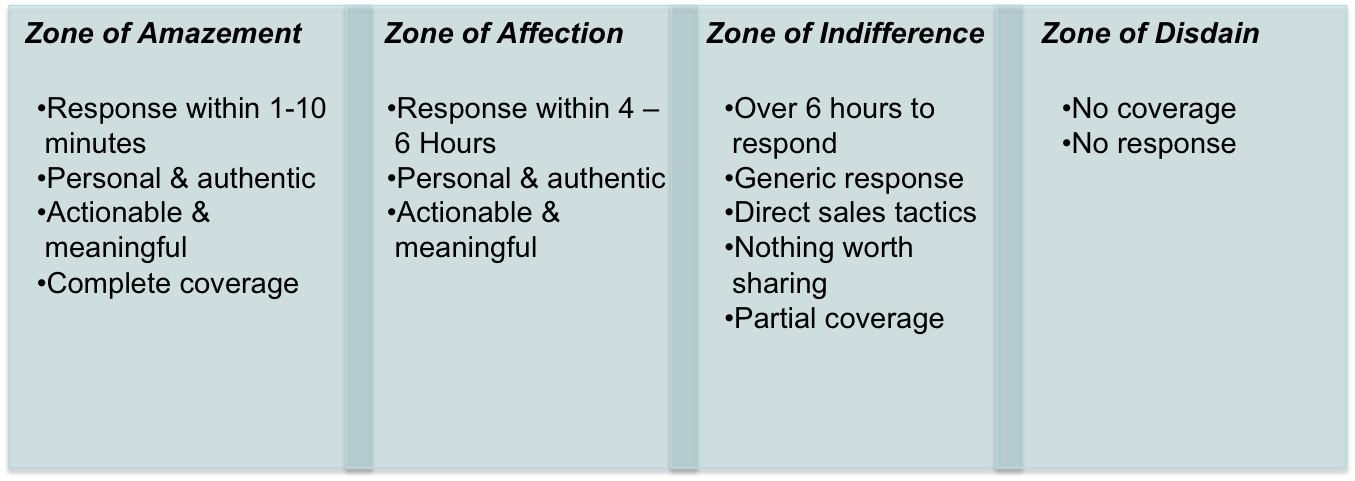
As promised some time ago, here is the second post about building a listening and engagement framework.  In my previous post on the listening framework, I detailed out my approach and several of the tools and applications I use to get pretty good coverage.  But, listening is only part of the equation.  When and how you engage based on what you hear is more important but also more complex.  I place these activities into the "Four Zones of Engagement" which are primarily defined by how much time it takes you to act on what you have heard.

ZonesofEngagement  

How do you stay in the Zones of Amazement & Affection?  Apply dedicated resources and make use of tools like TweetDeck, BackType, CoTweet, Gist, Twitter, & Google Reader

Want to languish in the Zone of Indifference?  Set up a few Google Alerts and you'll be sure to stay there.

Does the Zone of Disdain sound appealing?  If so, do nothing and watch your competitors and new entrants eat your lunch by engaging your customers and prospects in a direct and meaningful way.

Differentiation

I hope everyone had a great 4th of July holiday and enjoyed great weather like we had in Seattle.  Every year, Kirkland has a big 4th of July parade complete with bands, floats from local businesses, and political candidates kissing babies.  The parade is preceded by a kids parade where children and their parents walk the parade route.  It is a site to see as wagons, strollers, bikes, and scooters make their way down Central.

We met up with some friends ahead of time and that is the reasoning behind my title for this post.  Good friend Nathan D'Ambrosia is a great software product manager that is looking for a new gig so he decided to take the opportunity to stand out and bring a bit of creativity to the job search.  The pictures below show his t-shirt which lays out his situation (front) and his credentials (back).  He even had a pocket full of business cards summarizing the same information with a link to his Linkedin profile.

NathanD_front

NathanD_back

He handed out a few during the course of the parade and definitely got a few comments about both the creativity and cleverness of the approach. 

I think this is a great example of how to differentiate from others.  It shows the creativity and determination of the individual plus makes for great conversation.

If you are looking for a rock star software product manager, let me know.  Or contact him directly – here's his Linkedin profile.