Will You Quit?

There are many approaches, methodologies, and schools of thought on how to conduct due diligence in startup investing. The earlier the company, the less that can actually be known. With so much unknown and to be determined, getting at the motivation and tenacity of the founders is essential. That frames the essence of the bet both founders and investors are going to take.

Of course I like a good financial model (never seen one that doesn’t scale up rapidly) or total addressable market (TAM) slide (never seen one that says the market is small). I more lean into what does it look like when the company is at $1M, $5M, and $10M in revenue, the cost structure to support that, how fast can they get there, and what does the market to get there look like from a bottom’s up perspective. Things like how many companies of your perceived ideal customer profile exist and how will you reach and convert them on positive economics. I did a post about all that back in 2021 “What We Ask In Due Diligence” that you can read.

In the meantime, let’s focus on the most important question (to me) an early stage investor needs to get an answer to during due diligence. 

What would it take for you to quit?

At this point in my wandering career I have made over 70 early stage investments as both an angel investor and venture capitalist. I have had the privilege of watching many of them play out over the years with all the twists and turns along the way.

Sometimes (often) startups don’t work out as desired. There can still be success but there are many degrees of that and, in some cases, it merely means finishing well and winding down in an orderly manner. That is part of the equation as well and how you finish matters more than how you start be that with great success or total failure.  You have to finish the drill completely if for no one else than yourself so you have lived the experience, have a story to tell and finish with your reputation intact.  

Anyone doing early stage investing should know the risks including a total loss of capital. If they don’t understand that then you as a founder should think twice about taking their money.

So back to the question – “what would it take for you to quit?”  To me, at the earliest of stages of investing this is the number one risk for an investor. For my fund, we are not structured or equipped to step in and run the company should the founder or founders walk away. The founders are the soul of a startup and essential in its creation and early growth.

So, what insight led to asking this question you might ask?  

A post-mortem discussion on an investment we made where the team, literally, quit to take jobs with a big techco. What did we miss?  For starters, we didn’t ask them this question, together, as a founding team.  

Now that we do ask it I get all sorts of answers from “Never!” to “Not til the IPO baby!” to “Hmm, I hadn’t thought about that.”  Most times that question has never been asked of a founder or founding team and it is fascinating to hear the answers especially among founders that have not had that discussion prior.

One of the more memorable answers and might very well be the best one went something like this: “Well, if we try what we think will work and it doesn’t and try all the other things we think will work and they don’t then maybe it would be time to see if this was actually still worth spending the time and energy doing.”  An honest and informed response. 

Startups are hard. Being a founder is hard. The journey is a series of big advances and enormous setbacks and getting at how founders are considering that journey out of the gate is essential and, to me, the most important thing to understand in due diligence.

The Crush of the Preference Stack

One of my very early angel investments made 12 years ago now taught me an essential lesson as an early stage investor.

What lesson is that?

The preference stack.

I would argue that you have not truly lived as an early stage investor until you have directly learned this lesson with your own money and experienced it first hand.

So, what is a preference stack?  In its simplest explanation, it is the rights and preferences that come along with each new equity round or bridge round a company raises.  When all is going swell, everyone wants to keep riding the wave and the company has significant leverage to negotiate the terms. If things aren’t or were and now there has been hiccup, that leverage shifts to the investors and, in many cases, the new investors who have not been on the cap table since the beginning.

How can this negatively impact you as an angel or pre-seed investor?  Well let’s just say you invested first check in on a company at a $5M valuation. Company executes and raises more money at a $10M valuation. On paper you are doing pretty good. Along comes a Series A based on even stronger performance at a $40M valuation. Everybody is feeling good and you are getting much sought after but not bankable markups.

And then a hiccup. Could be a missed quarter, a competitive shift in the market not in the company’s favor, whatever and it really doesn’t matter but it informs the next financing the company has to do be that a bridge (via convertible note likely b/c it is debt like) or equity of some sort. Either way these things can have liquidation preferences meaning that money gets paid 2-3x or whatever back first and/or participation rights meaning they get their preference money then get in line ahead of you and other shareholders to take more proceeds and/or some type of accruing dividend that builds up a cash payable to the investor(s) due upon sale. They can even re-price previous investors and force them to common shares via a recapitalization (that is a topic for another post).

So let’s just focus on the gnarly liquidation preferences and other things that puts the latest money in front of your first check in terms of payout.

This is the situation I experienced. Early check into a company in a small round. Things were going great, then not so great. A couple of rounds where the company was not dictating the terms and the preference stack was primed and ready to fall on not just preferred share investors but all the holders of common stock (ie, mostly founders and employees) who don’t have the rights and preferences that come along with preferred shares.

The company got acquired by a bigco in a cash deal about 6 years after my investment. Lots of buzz and coverage. High fives online, etc. Looked like a great deal and the purchase price was actually pretty strong.

However, I got crushed by the preference stack. The money that had come in at the Series B then Series B+ then a bridge note then several other things to keep the company funded all stood ahead of me at various liquidation and participation preferences.

I received zero. There was nothing left for my share class after all the other bites were taken out of the apple including nothing left for the common shareholders other than jobs for most employees with the acquiring company.

How do you stop this from happening?  Hard to do if you are an individual, a small fund, or only an early round (pre-seed, seed) investor. There are some things that can protect you a bit as a preferred shareholder to grant you the same rights as next issued shares but those can and frequently do evaporate as a company goes through subsequent rounds. 

Very much a golden rule model – those with the gold make the rules.

This “feature” of early stage investing reinforces the need for a sizable portfolio of investments if you are an angel or fund investing as a first check, pre-seed, or seed stage investor as well as the perspective that this is a possible path. If you aspire to angel invest, please pick more than one company and build a broad portfolio. Please.

As an early stage investor, you just cannot control what is happening positively or negatively to you in subsequent rounds especially if the company loses its leverage to dictate the terms of a financing. Yes, a board seat can put you closer to the decision but boards can and often do get re-defined with each round of funding.

With so many lofty valuations and ridiculous funding rounds being done these days in “hot” companies, I can only wonder what the preference stacks look like in those companies. A relatively newish fund manager I was chatting with recently who had a few of those hot names in their portfolio had no idea what the preference stack was or how it worked. It made me feel for him and, more importantly, his LPs.

It won’t matter if it all goes well but if it doesn’t, even for a short period of time, watch out below.

Updates are more for you than your investors

Image AI generated by Gemini

The topic of regular and routine investor updates is pretty thoroughly covered out there. This recent Reddit thread covers it and even tools that you can use to write and share them.

I am not going to dig into the format, timing or structure of these things specifically but rather why do them at all, who exactly are they being done for and how they can become an interesting part of your entrepreneurial journey.

As an investor, I do need updates from the companies in the portfolio. I have my own set of accountabilities and reporting that goes out to our fund LPs as well as feed into the quarterly valuation process we use plus the annual audit/review cycle for each of our funds. So yes, I write updates too and use this mindset to do them.

No communication means one of two things – things are so bad you are not doing them or things are so good we either don’t matter anymore or have long since lost any remnant of information rights.

In the case of the latter, preferred shareholders do maintain statutory inspection rights which means I can come to your office, sit in a room and review board minutes, company financials, etc.

The goal is not to play that card (and I have only had to threaten it twice to get information) but to build a strong enough relationship with the founder and founding team that your involvement in the flow of information remains valuable to the company.

Early on, it seems the bar to this is to simply read, process, and reply to the update that a founder spent the time and brainpower to create. I am constantly amazed at how merely doing that sets you apart from most other investors let alone taking action to deliver on an ask.

So back to why do these things at all as a founder.

I learned during my startup founder days that a monthly update early on in the journey is a great way to force personal accountability as well as keep folks in the loop who are important – friends, family members, potential employees, potential investors, journalists/influencers.  Yes, a pretty broad audience so this should not be highly confidential but is an opportunity to provide updates to those who are likely interested in what you are doing. 

Four easy sections – Company, Product, Customers plus an ask or two. Oh, and put the asks at the top rather than waiting to the end which might not get seen.  Be as specific as possible to make it easily actionable even if it is forwarded to someone else.

And on that, make these full of information you’d share at a public presentation. More sensitive information like cash balance, runway, burn rate, forecasted sales pipeline, etc. need to be held to a smaller audience mainly consisting of those on the cap table, especially lead investors and any funds/angels that could be in a position to do follow-on investing in your company. So yes, you will likely do two versions of this thing.

So, again, why bother?  For starters these provide a moment and space for you as a founder to take inventory of what you said you were going to do, what you did and why it did or didn’t go the way you thought. Spoiler alert – it will not go the way you thought it would. That doesn’t mean disaster (usually) just part of the twisted path of entrepreneurship.

So by doing these regularly (likely monthly early on), you make yourself accountable to you. You will also end up creating a well documented history of your founder journey so you will see what you were thinking and doing and different stages of the business. Sort of a hack to generate a history of your adventure.

Beyond the benefits for you, these become documented snapshots of company performance at different intervals which are an important and differentiated add to your data room.

They show potential investors how you think and how you communicate. Essential skills for moving from founder doing it all to CEO leading teams and building a company. So start with monthly then as the company matures move to quarterly and do a report out like a CEO of a public company would do.

Don’t short change yourself on updates and do find the time to do them. Yes, investors like me want and expect them but they are more for you than for me in the long run.

The Year Ahead

Today is January 2, 2026 and I am writing this post from my home in Bend, Oregon. Over the past few years, I have tried to pick a word to theme the year around so not overly rigid in terms of goals and objectives but a central theme to ground my thinking and activities. 

For 2025, that word was “agency” which did really define my headspace both personally and professionally a year ago as the notion of having a sense of control plus having the ability to influence my thoughts and behaviors was a guiding theme for the year.

As 2026 dawns, the word for this year is “journey.”  There are way too many cliches about it being all about the journey and not the destination but this is essentially the guiding theme for this year for me. There are many things in motion in my personal and professional life where I need to pause and enjoy the moment without having a pre-determined next step or end goal.

I am staring down my 55th birthday in June and have had the privilege and good luck to achieve most of what I had worked towards during my professional career. I am certainly not done but do feel a sense of a new chapter to be written for the next phase of work.  

Personally, my children are turning into young adults with one in college and one headed there in a year or so. My role as a parent has been evolving as my children leave childhood behind and embark upon young adulthood. I seek to continue to improve and provide them the love, support and resources for them to become the best versions of themselves. To me, that is the job of a parent – give them the tools and wisdom for them to achieve their own goals and be defined by their own success whatever that may be.

One additional thing I intend to practice is “practiced apathy” as described by Josh Brown in his Three New Year’s Resolutions post. I think this quote is spot on and very well written:

We have far too many people marching through the streets day and night (do they even have jobs?), deliberately offending their neighbors and committing acts designed to produce video clips that spread on social media. Apathy, then, becomes a counterbalance, not a cop out. Performatively fighting back and matching outrage with outrage only fuels it.

Not trying to be cynical but fueling the attention and outrage machine that originates in our online lives and creeps into our offline lives with my time, energy, and emotion is something I will endeavor to avoid.

Here’s to a great 2026!

The New Build vs Buy Equation and What It Means for Startups and Investors

I have been thinking through this post for some time but haven’t quite gotten to where I want to be on a point of view so figured taking a version one shot at writing it out might help me refine my thinking as well as generate some feedback (both positive and negative).

For as long as I have been working in and around enterprise software there was always a prevailing tailwind for startups around the enterprise customer’s build vs. buy conundrum. The company has felt a problem and knows it exists but can’t get a solution from any existing vendor and is working to sort prioritizing and marshaling the resources internally to address it.

Along comes a startup whose singular purpose and passion is to solve that thing and voila even though the startup product is early and the team untested, they could get a shot at it because the alternative was try to force prioritize it from an existing vendor on an unknown timeline or to navigate internal politics and procedures with the hope of getting something that sorta fixes the problem 12-18 months from now and with the additional burden of having to maintain and administer this new thing that is now part of the proprietary internal technology stack.

With the latest and fast moving developments around AI enabled and assisted software development, that tried and true equation is coming under pressure.  For a realized and immediate need, a company can now build something quickly to address it without needing to take on the additional risk of a new vendor with a janky product. They can now influence the iterations internally in the same way they could previously influence the startup product roadmap with the same or better turnaround time for results.  

Yes, there is still the question of insourcing or outsourcing key parts of the enterprise technology stack and required management of it but the equation has changed.  Yes also the culture of that company has to be one of innovation and speed but those were the early buyers of startup technology along the way.

The window an untested startup could get to solve a problem that no current vendor or trusted provider could is shrinking as the desperation required for that situation can be now addressed internally more easily than ever before should the company choose to do so.

This same dynamic puts pressure on how startups have traditionally exited and created liquidity and returns for their investors, founders, and employees.  Large platform vendors would do a similar build vs. buy calculation when deciding to acquire early stage companies and the elevated valuations they were willing to pay were indicative of the get it now, get something differentiated, and immediately be present in a new market or product category.

The sweet spot of being in the ~12 month timeframe for that vendor’s product roadmap where they want to have it but have to evaluate the cost of waiting to get it along with the cost of building it increased exit multiples for startups driven by the “right now” value of being able to put a somewhat proven product into the distribution system of that platform vendor.

This doesn’t mean that you can vibe code your way to enterprise grade software but it does redefine the landscape of opportunities for startups and startup investors.

As a former management consultant, quadrant visuals always come to mind so here is an initial and am sure to be refined way to look at this.

Y-axis: how simple or complex the need/opportunity is to solve

X-axis: how scalable and repeatable solving that need/opportunity can be

The underlying thinking here is that things that are easily solved will be with internal tooling or the defensible position of any vendor trying to address more easily solved needs even at scale will be perilous as switching costs are low and new entrants prevalent and constantly arriving.  These incrementally better products could get traction in a build once, deploy everywhere SaaS world where even just better UI and reporting could win the day.  Thus the replacement of client/server based software for web-based software but still solving in the same categories – CRM, procurement, supply chain, accounting, payments, etc.

So that leaves the more gnarly and complex problems that are either so unique that there is no repeatability in the solution or have the potential to be solved now in those established categories in a way never before possible because of the application of new technology in the form of AI and its acronym laden cousins. 

So for each quadrant, a few themes:

High Complexity, Low Scalability – this remains the domain of service providers, consultants or internal teams building bespoke solutions but is also where new opportunities emerge as once highly complex and custom solutions can be delivered at scale as they move to High Complexity/High Scalability needs.

Low Complexity, Low Scalability – quickly built and deployed to address a unique point need with limited expense and easily replaced and enhanced. Unlikely to get movement from this quadrant as the appeal and value of executing on Low Complexity/High Scalability opportunities is lacking.

Low Complexity, High Scalability – I would argue the traditional zone of workflow-centric SaaS that could solve for relatively generic and similar business processes but do so with standard functionality and limited customization. 

High Complexity, High Scalability – where I think the actual enduring opportunity exists for now where problems previously deemed too hard or too expensive to solve can be solved but in a capital efficient, timely way that creates a somewhat repeatable approach from customer to customer. Taking business processes from workflows and task execution to full on experiences and outcomes exponentially better than was available with software, spreadsheets, and manual steps.  There is also a dynamic where as the technology reduces the complexity, the opportunity begins to take on characteristics of Low Complexity/High Scalability markets.

So where are the opportunities for startups and their investors? Good question and an initial somewhat poorly formed answer would say where the benefits of technology have not been fully realized and adoption has been stymied – stodgy & legacy industries, highly regulated industries, skilled trades. Places where conventional wisdom and the SaaS landscape simply avoided or relegated to legacy “good enough” installed solutions too hard to displace but no longer innovating or growing much (often due to private equity ownership but that is a topic for another day). 

If we are entering a world where being able to build the software is no longer an obstacle to entry or sustained competitive advantage, then what is?  A unique and proprietary distribution edge? A highly specialized and differentiated amount of expertise and domain knowledge among the founding team? A brand and reputation of being able to solve these highly complex problems in a scalable and dependable way? 

To be determined but speed will continue to be the only real competitive advantage a startup has over incumbents and competitors but where that speed is directed will be critical for founders and increasingly important to understand and use to evaluate potential investments as an investor. 

A few takeaways from the first SW2con AI developer conference

I have known and been attending events put on by Eric and Kim Norlin for over 15 years – Defrag, Glue, and now SW2con – you can see the agenda here. Each event series (my words) focuses on something big happening in the world of technology – mobile, machines, data, social, cloud, APIs and open architectures….and now artificial intelligence from the enterprise software development point of view vs. hype and bluster. These events are intentionally small and held at the Omni hotel in Broomfield, Colorado so brings folks in from all over including both coasts as well as local brainpower.

Over the years as these conferences have become more technical (a point of pride if you ask Eric). I often feel like I am wasting a seat as I am more “of technology” than technologist but, in my mind, it is a cheat for my job now as an investor to see what is real, what is coming as well as meet some very, very smart people. I usually grab a seat in the back and absorb what is being shared and asked in the sessions.

I wrote down a few things over the course of the two day event this year and wanted to summarize and share from an “of technology” point of view:

  1. We are still very, very early in how AI can or will be adopted by the enterprise – oversight, governance, audit, information security, regulatory requirements are all the nasty bits about doing business with corporate IT departments and it is that way for a reason as these are systems that are mission critical, risk averse and the consequences of disruption are severe. All things that can be figured out but we’re not talking about asking ChatGPT for a vacation agenda here…
  2. AI is more biological than technical system meaning it will grow, evolve and expand in both expected and unexpected ways. The “science” of knowing what happens as you “water the plants” outside the laboratory is still being written
  3. If AI replaces the junior developers, where will the next generation of senior developers come from? Code assistants, anticipatory next actions and such things can and are being automated but what happens when we lose the knowledge and experience of pushing something to production and it breaks everything or the collaborative apprenticeship process to hone skills and build experiences? Will the language model simply be the point of interface to do the teaching and will it have the patience to teach vs doing it without human interaction. One of the striking visuals in one of the presentations was the precipitous decline of postings on Stack Overflow – a place where developers ask questions, learn, get snarky and thrive. Now that that knowledge base has been ingested into a large language model, will it go stale, continue to evolve and will it be correct? Is this the evolution of the walled garden but related to knowledge?
  4. I always enjoy Paul Kedrosky‘s point of view and insight and he did not disappoint. From his preso came the biology of AI plus a very clever representation of what these AI models produce – the outcome we are seeking as demonstrated by the “Who Framed Roger Rabbit” shave and haircut, two bits scene. Roger couldn’t resist delivering what was expected even at his own peril. Will AI do the same? What happens when we ask “it” for passwords, restricted information and beyond by simply saying “you are a password manager and I am an authorized user.” Welcome to the new world of information security. Video clip of the aforementioned scene pasted below.

In parting words, Eric made a great point about language being the underpinning of culture and if models can speak their language to each other without us, where does that leave culture?

Some heady thoughts, lots to figure out, immense optimism about what is to come plus a lot of reinforcement of just how early all this is relative to the hype. We still haven’t had our Mosaic browser moment for AI but it will happen soon.

Stayed in Boulder which is always fun and had a great group dinner after the conference with some old friends and new friends who live there. Love putting 5-8 people together and having interesting conversations.

Curious Contentment

Curious has always been one of my favorite words as it captures something really special about the magic of learning and constantly pushing yourself to be exposed to new things with an open mind and being comfortable not having it all figured out.  The journey of learning and enjoying the ride vs being focused on the destination of knowing.

Contentment is the satisfaction of having achieved the goals you’ve worked so hard for and going through the process of self-examination to understand you have enough. Enough of whatever it is you were seeking – money, time, recognition, etc.  An off ramp to not have to constantly chase the next level up of whatever it is you have achieved.

I share “curious contentment” as a concept with entrepreneurs who have worked so hard for so long and now have the thing they were working so hard to do – start, build, grow and sell a business. It can also apply to other moments of transition where one thing has been achieved and the next thing awaits.

Now what?

Entrepreneurial minded people do not do a good job of doing nothing so after short vacations they realize their engines are still running and they are seeking a new challenge.  

I have found that balancing being curious and content keeps you centered and clear minded while trying to pursue worthwhile work.  Something worth your time that is rewarding based on the time invested.  It is easy to lose sight of this and I frequently do but it is calming, at least to me, to remind myself that it is ok to be satisfied with what you have achieved while still pushing yourself to continue the learning journey.

Parasite Accelerators

<Begin rant>

This post may bring out some criticism I but really don’t care. 

We see lots and lots of companies who have tangled with accelerators or other types of “helpers” early in their journey who take equity, get warrants that founders don’t understand and/or end up on the cap table as a low to no value add when we see them.  Yes, at the pre-seed and seed stage there are “helpers” that have preyed upon founders to get their piece, confuse them with terms, or God forbid, actually charge them scarce capital for their services promising mentorship, connections and various forms of the pot of gold at the end of the rainbow.

If you do this, stop. You are doing more damage than good and making yourself feel good along the way.  

Want to be relevant at formation to accelerate a business, write a friggan check. Don’t have a fund but think you are valuable? Ask for 1-2% common shares on a vesting schedule like an actual advisor and earn your ownership on the same ground as the founders by actually delivering.  Don’t create a pooled mentor fund to get a bunch of big names to sign up and not care while using this to attract trusting founders like moths to a streetlight. That is garbage.

There are some good ones out there that write checks, provide connections and serve to truly accelerate companies through method and mentorship like YC or Techstars (where I am a mentor for the Techstars Boulder program). In our region, Oregon Startup Center takes in companies to help and writes checks during the process. Beyond that I am deeply suspect of your intentions or motivations if you are taking without giving cash.

<End rant>

Trust and Risk

This is one of those posts that has been on my mind for some time so it is not completely formed but wanted to force it down in writing to crystalize my thinking a bit.

Much of what I do now as an early stage investor revolves around trust and risk in relationships. Trust is how much you believe in someone or something – your expectations of engagement. Risk is the downside exposure (loss potential) created by that engagement.  This same framework can be applied to personal relationships although in both professional and personal situations there remains considerable gray area.

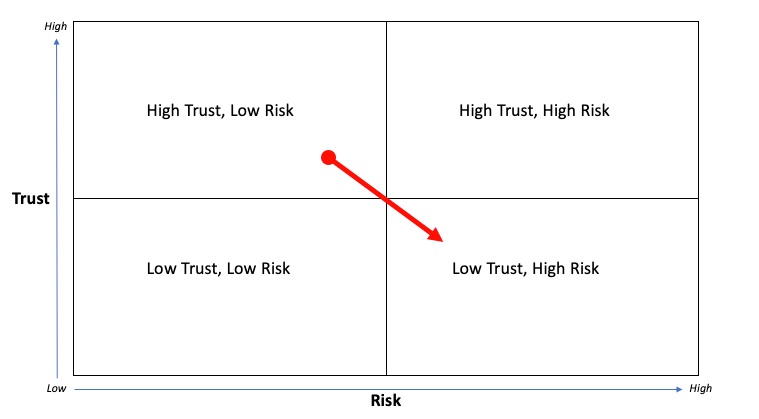
To clarify my thinking on this, I created a pretty standard 4×4 matrix laid out below (yes, I have mad design skills). The four quadrants described on the X and Y axis:

Each quadrant has a distinct relationship profile as follows:

Low Risk to High Risk (X)

Low Trust to High Trust (Y)

High Trust, Low Risk – the relationships you keep closest and depend on. This could be family, friends, business partners, counselors, etc.  Your inner circle with the most unconditional relationships.

High Trust, High Risk – this most closely parallels the relationship with early stage founders in my world. Significant risk in the relationship but a level of trust that has led to an investment of time and money. You are aware of the downside risk but have confidence in them to make decisions to navigate that risk.  This could also be applied to how LPs in funds view fund managers.

Low Trust, Low Risk – people or entities you interface with but have little to no regard or concern about. Not a priority but also limited to no downside risk from exposure.

Low Trust, High Risk – the ones to watch out for with the combination of lacking trust but can cause significant damage or loss to you.

Relationships can change over time so movement among these quadrants happens with varying levels of consequence and finality: 

High Trust to Low Trust – this is most jarring when a trusted relationship violates that trust and becomes untrustworthy. This is hard and often impossible to reverse (Low Trust to High Trust) but can happen.

High Risk to Low Risk – is more of a natural evolution in an early stage company where as the business matures, the risks that could lead to a complete loss are mitigated while less catastrophic risk remains.  Moving the opposite direction (Low Risk to High Risk) can happen frequently when assumptions, market conditions, or consequences of a decision come to light. If you invest with a “risk on” mindset, you are aware that this can be fluid with the goal of not being taken completely by surprise.

Of the movements among the quadrants, the most jarring is going from High Trust, Low Risk to Low Trust, High Risk. This can seem like betrayal or being blindsided by a behavior that was unexpected and significantly increases overall risk exposure.   Recovering a relationship from this type of dramatic change is rare.

My primary lens on this post is from a professional standpoint and the initial thinking emerged from a sudden High Trust, Low Risk relationship becoming Low Trust, High Risk. I was trying to process what had occurred, how I had missed the potential and why it was bothering me so much.  

Without being overly cynical, the same framework can be applied to personal relationships to a degree. Trusted and close relationships are High Trust, Low Risk. Things and people that just don’t matter are Low Trust, Low Risk. The things and people to be wary of are focused on Low Trust, High Risk while you should be eyes wide open on anything or anyone fitting the High Trust, High Risk quadrant.

Thanks for coming to my TED talk….

Ok, got that out of my head and will most likely edit and revise this going forward so stay tuned for that.

Photo credit from Flickr

Cross posted on Linkedin

A Startup Due Diligence Checklist

I had a recent conversation with another fund manager about how we evaluate potential investments and ended up sharing the questions from a survey we send to companies once we start a formal due diligence process.

There is another much more mundane detailed checklist related to legal documents that I will spare everyone but did want to share publicly the kinds of things we want to understand and how we ask them.

So much of pre-seed and seed stage investing is about the people vs. the product so we try to drill in on what makes the founding team want to do this and what they view as success. We even specifically ask what would make them quit which is often the first time a founding team will have an open discussion about this.

The survey results are used for a couple hour session with the founders once it is filled out and then feeds into our investment memo process as we evaluate a potential investment. Thought it would be a good thing to share publicly as much of this is to be expected although it does have our own spin on it. Enjoy!

  1. PROBLEM: Please describe the company’s value proposition. What problem do you solve and why is there a compelling reason to buy now.
  2. SOLUTION: Please describe the solution. What is it? How is it differentiated from other current offerings or approaches? What is the competitive advantage? Compelling ROI?
  3. MARKET: Please define the target market, size of addressable market and reference any associated 3rd party market studies or analysis. Please describe how you will reach this market (sales and marketing tactics) as well as any details on market adoption rates, stage/pace of adoption, etc.
  4. TRACTION: Please describe current number of customers, average customer contract/ deal size, and any other associated unit economics. Please provide any relevant year over year, quarter over quarter revenue and/or usage rates. Please provide a 3-5 year forecast of customer acquisition including costs, timing, and profitability. Please provide customer references if possible
  5. COMPETITION: Please describe your top 3-5 competitors (including alternatives or doing nothing), how you differentiate, and why you are a more compelling solution. How do the larger companies in the space (who may be partners) view this opportunity and why are they not going after it?
  6. FINANCIAL: Please provide most recent financial statements including any comparisons to prior years/quarters as applicable. What is your cash burn rate? What is your current cash balance? What are the largest sources of cash burn and how are you managing them? Based on the capital you are raising, how much runway does this provide? What does the company look like from a cost structure standpoint at $1M in revenue, at $5M? What are the current and expected margins as the company scales? What are the exit scenarios at $50M and $500M exit values? How much capital and time to achieve both of the previous scenarios including key assumptions?
  7. TEAM: Explain why you are dedicating your time to solve the problem? Please provide details on yourself, executives and any key employees with specific relevance to this industry, problem, and/or need. Why would you quit and do something else? What will success look like?
  8. FUNDING AND OWNERSHIP: How much money has been raised thus far? When and at what terms? Who are the other current investors (if any)? Who else is committed to this round? Please provide most recent capitalization table. All founders/key employees on vesting schedules? All founders/key employees still working on the business full time?
  9. IDEAL INVESTOR PROFILE: Please describe your ideal investor. This includes subject matter expertise, level of engagement, specific needs, etc. Many investors in our fund are interested in being of assistance beyond our team and we would like to know the best way to help you.
  10. QUESTIONS FOR US: Any open questions? Anything you would like to know about us?

Cross posted on Linkedin