Why Positioning Matters

Happy Labor Day everyone.  I thought a post on "positioning" was timely because not only is it something we are continuing to focus on and evolve at Gist but it also came up last week in one of my mentoring sessions as a NWEN Advisor.  Also, it is no small effort to get right so thought it appropriate to discuss on Labor Day.

What is positioning and why is it important (according to me)?

The positioning strategy is a competitively focused statement of what makes a company different and better than the competition.  It is a description of how prospective customers, partners, etc. should think of the company relative to the competition.  A fundamental of good positioning strategy is creating perceived differentiation in an area that is important and relevant to those audiences.  Since positions are “relative to the competition,” it is important to understand how competitors are currently perceived and how they are trying to position themselves.

How do I come up with it (not sure where I got this from originally, so apologies for no source reference)?

[Company Name] provides  [product or service category]
For [your beachhead target customer]
So they can  [product’s primary benefit].
Unlike [the product alternative]
We [key differentiator]

This is definitely an exercise about picking the right words but in order to pick the right ones you must understand the broader landscape and how companies operate within it.  In an early stage company this is not a one time effort that you complete and move on.  It is a constant and iterative process as you learn more about your customers and market and the difference between how you want to be perceived and are perceived becomes clear.
Marketing Mayhem

Over the past year plus, I have been working with a whole new set of tools to understand and reach customers/prospects/users.  This includes Twitter, Linkedin, Facebook, blogs, blog comments and the associated technology to access and analyze what is being said and who is saying it.

Unlike mainstream marketing thinking, what I have been doing has cost very little money and utilizes new tools to reach people in the new places they are spending their time.  More importantly, the leverage in selling resides disproportionately with the buyer these days.  They have instant access to information about you, your competitors, and even the ability to connect with your current and former customers all without your help or involvement.  Understand this is reality and embrace it.

So, what should you do if you are trying to sell something, launch something new, or just expand market share within existing target market?  Set up and make use of a Listening & Engagement Framework.  Check out my previous posts on it to understand what the heck I am talking about.

I have been making extensive use of this type of framework at Gist and put together the presentation embedded here to highlight both what we have been doing as well as the thinking and assumptions behind it all.  Check it out and let me know thoughts and feedback.  One thing I have learned is that the rules are still being written and best practices emerge daily on the best way to use all this stuff as a business.

Building an engagement framework

Apologies again for the slow posting recently.  Life and work got in the way a bit…

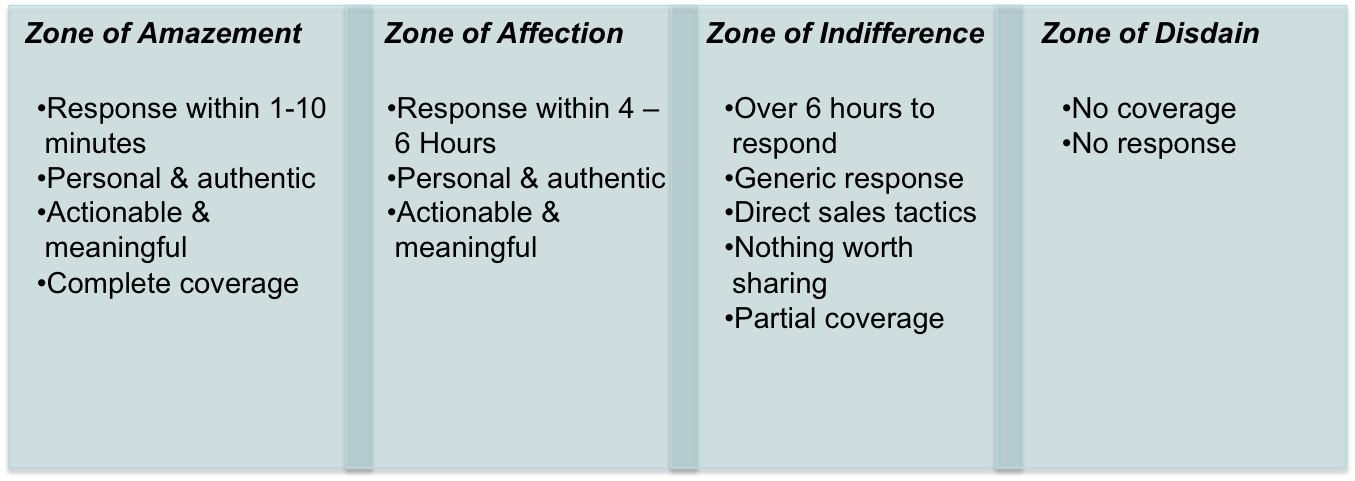
As promised some time ago, here is the second post about building a listening and engagement framework.  In my previous post on the listening framework, I detailed out my approach and several of the tools and applications I use to get pretty good coverage.  But, listening is only part of the equation.  When and how you engage based on what you hear is more important but also more complex.  I place these activities into the "Four Zones of Engagement" which are primarily defined by how much time it takes you to act on what you have heard.

ZonesofEngagement  

How do you stay in the Zones of Amazement & Affection?  Apply dedicated resources and make use of tools like TweetDeck, BackType, CoTweet, Gist, Twitter, & Google Reader

Want to languish in the Zone of Indifference?  Set up a few Google Alerts and you'll be sure to stay there.

Does the Zone of Disdain sound appealing?  If so, do nothing and watch your competitors and new entrants eat your lunch by engaging your customers and prospects in a direct and meaningful way.