
Trust and Risk

This is one of those posts that has been on my mind for some time so it is not completely formed but wanted to force it down in writing to crystalize my thinking a bit.

Much of what I do now as an early stage investor revolves around trust and risk in relationships. Trust is how much you believe in someone or something – your expectations of engagement. Risk is the downside exposure (loss potential) created by that engagement.  This same framework can be applied to personal relationships although in both professional and personal situations there remains considerable gray area.

To clarify my thinking on this, I created a pretty standard 4×4 matrix laid out below (yes, I have mad design skills). The four quadrants described on the X and Y axis:

Each quadrant has a distinct relationship profile as follows:

Low Risk to High Risk (X)

Low Trust to High Trust (Y)

High Trust, Low Risk – the relationships you keep closest and depend on. This could be family, friends, business partners, counselors, etc.  Your inner circle with the most unconditional relationships.

High Trust, High Risk – this most closely parallels the relationship with early stage founders in my world. Significant risk in the relationship but a level of trust that has led to an investment of time and money. You are aware of the downside risk but have confidence in them to make decisions to navigate that risk.  This could also be applied to how LPs in funds view fund managers.

Low Trust, Low Risk – people or entities you interface with but have little to no regard or concern about. Not a priority but also limited to no downside risk from exposure.

Low Trust, High Risk – the ones to watch out for with the combination of lacking trust but can cause significant damage or loss to you.

Relationships can change over time so movement among these quadrants happens with varying levels of consequence and finality: 

High Trust to Low Trust – this is most jarring when a trusted relationship violates that trust and becomes untrustworthy. This is hard and often impossible to reverse (Low Trust to High Trust) but can happen.

High Risk to Low Risk – is more of a natural evolution in an early stage company where as the business matures, the risks that could lead to a complete loss are mitigated while less catastrophic risk remains.  Moving the opposite direction (Low Risk to High Risk) can happen frequently when assumptions, market conditions, or consequences of a decision come to light. If you invest with a “risk on” mindset, you are aware that this can be fluid with the goal of not being taken completely by surprise.

Of the movements among the quadrants, the most jarring is going from High Trust, Low Risk to Low Trust, High Risk. This can seem like betrayal or being blindsided by a behavior that was unexpected and significantly increases overall risk exposure.   Recovering a relationship from this type of dramatic change is rare.
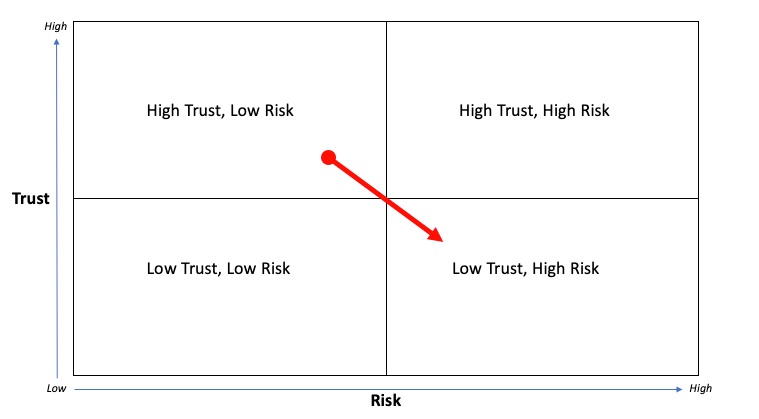
My primary lens on this post is from a professional standpoint and the initial thinking emerged from a sudden High Trust, Low Risk relationship becoming Low Trust, High Risk. I was trying to process what had occurred, how I had missed the potential and why it was bothering me so much.  

Without being overly cynical, the same framework can be applied to personal relationships to a degree. Trusted and close relationships are High Trust, Low Risk. Things and people that just don’t matter are Low Trust, Low Risk. The things and people to be wary of are focused on Low Trust, High Risk while you should be eyes wide open on anything or anyone fitting the High Trust, High Risk quadrant.

Thanks for coming to my TED talk….

Ok, got that out of my head and will most likely edit and revise this going forward so stay tuned for that.

Photo credit from Flickr

Cross posted on Linkedin

Three keys to a successful modern marketing plan

I assembled these notes in advance of a presentation I thought I would be giving.  That didn't come together but I did want to share these three points here as "keys to a successful modern marketing plan."  There are definitely more parts to a plan than what is listed here but I believe these are especially relevant to what you can do and must do given how technology has changed both the approach and pace of marketing.

1.  Launch is a process not an event

Launch is not a one time event for your company.  Launch is a continuous process whether it is the release of new features, a partner announcement, or just a continuous flow of information and events that you are driving. 

I am not a fan of the "one shot" launch events.  Not because I don't think Techcrunch 50 or Demo are good events.  I just believe there are way too many variables that impact a positive outcome…and that the results of the outcome are fleeting.  Isolating everything that could potentially derail a demo or conflicts that could lead to a sparse audience is pretty much impossible so don't set yourself up for disappointment. 

I recommend laying out your time line and finding the events that support it.  Do not spend buckets of money on events although many require some level of sponsorship to get on stage.  Just be frugal about spend and critical of the opportunity.  If it seems to good to be true or it is presented (sold) as the "make or break" event for your company, move on.

2.  Identify on-line influencers in your domain & meet them

Everyone can be a publisher these days and there are no shortage of bloggers, podcasters, and amateur journalists in just about every industry and sub-industry.  A bit of time using a search engine will reveal lots of targets for your given domain that have huge readerships.  Engage with these on-line influencers, share your expertise, and provide content for their audiences.  Traditional newspaper circulation continues to decline so focus on those who focus on what you do and in your space rather than hope for that big article in the Wall Street Journal.  If what you are doing and saying is compelling (and you are really are on expert), those opportunities will find you.

3.  Embrace new technologies but don’t lose sight of fundamentals

Social media is a tactic, not a profession.  It has a role in the marketing mix and is a phenomenal customer support tool.  See it for what it is and understand it is a platform for your brand.  Use channels like Twitter, Facebook, and your blog to share news about you, about your industry, and to show off your expertise as well as that of others (yes, including your competitors).

For a bit of additional perspective, watch this video about how the fundamentals of B2B marketing stay the same:

Don’t forget about accounts receivable

Having run my own consulting company and been part of several start ups at this point in my life, I can't emphasize enough the need to focus on accounts receivable.  This is the life blood of your venture and your ticket to freedom (if you are venture backed) – inbound cash flow.

Yes, it is important to get that first customer or client but pay attention to payment terms and cash flow implications.  Big companies are big and don't always promptly pay an invoice…so be diligent and understand that your near term cash needs are not the most important thing for your customers.

Be creative, structure pre-pay agreements, and provide incentives for early or complete payment.  It will benefit you in the long run. 

Why Positioning Matters

Happy Labor Day everyone.  I thought a post on "positioning" was timely because not only is it something we are continuing to focus on and evolve at Gist but it also came up last week in one of my mentoring sessions as a NWEN Advisor.  Also, it is no small effort to get right so thought it appropriate to discuss on Labor Day.

What is positioning and why is it important (according to me)?

The positioning strategy is a competitively focused statement of what makes a company different and better than the competition.  It is a description of how prospective customers, partners, etc. should think of the company relative to the competition.  A fundamental of good positioning strategy is creating perceived differentiation in an area that is important and relevant to those audiences.  Since positions are “relative to the competition,” it is important to understand how competitors are currently perceived and how they are trying to position themselves.

How do I come up with it (not sure where I got this from originally, so apologies for no source reference)?

[Company Name] provides  [product or service category]
For [your beachhead target customer]
So they can  [product’s primary benefit].
Unlike [the product alternative]
We [key differentiator]

This is definitely an exercise about picking the right words but in order to pick the right ones you must understand the broader landscape and how companies operate within it.  In an early stage company this is not a one time effort that you complete and move on.  It is a constant and iterative process as you learn more about your customers and market and the difference between how you want to be perceived and are perceived becomes clear.

So, what is Gist?

Arguably, we have been perfectly vague publicly about what Gist is, what it is used for, and how it fits into your daily life.  This is due in large part to being in a limited release where we continue to add features, refine the product, and incorporate feedback from a phenomenal set of beta users. 

So the question remains, what is Gist?  Is it a contact manager, better contact management system, new way to think about CRM software, a new type of sales or business intelligence software?  I guess the answer is that it embraces a bit of all of these things focusing on blending how your contacts, connections, and all the associated content you share and they generate comes together for your use.  Kind of a whole new approach to personal relationship management that combines elements of all of the above.

I use it daily because a) I work there and b) because it fits with what I do – contact people, respond to people, follow up with people, look for a reason to reach out, etc.  Ultimately, Gist takes the broad set of people that you communicate with or desire to communicate with, aggregates information about them, and serves it up to you in rank order with you having to do pretty much nothing. Oh, and it really shines when you use it inside MS Outlook or Salesforce.com (supported in our most recent beta release).

Sound cool?  Watch this video for a more detailed product tour by yours truly and drop a comment or email to me – robertcpease at gmail dot com if you want to try the beta.