First Job – Fraser Suyetsugu

Fraser

Here's another first job story from a friend here in Seattle - Fraser Suyetsugu. Fraser is a great guy and Salesforce.com master who has helped me many times with questions related to it and customer relationship management (CRM) as a whole.  You can also follow him on Twitter @Frasuy and be sure to check out all the First Job posts.

From Fraser:

1st job – was a paper route carrier starting at the age of 13 I believe. Peddled the (defunct) Journal American and Seattle Times through the Lake Hills and Chevy Chase neighborhoods by 6:30 am. The other half of that job was a ‘collection agency’. Back then you had to chase down your customers and collect their money or you didn’t get paid. Did that job for almost 4 years I believe. Shoot, if they had a 401k I could plan my retirement a couple of years earlier.

2nd job – courtesy clerk and stock boy at the (defunct) Overlake Market which is now a Goodwill center in the Overlake area. Great job since it was customer facing and I was making bank ~$6.00/hr. Who-hooo!  I remember learning about unions because I was mad that some of my paycheck was siphoned off to pay member dues. I am pretty sure that was my first “real” job since you had to be 16, had to fill out an application and interview. It was the big time!

There are many others along the way but those are the two that ordained me to the working/responsibility world.

Great stories and the second one about a newspaper route.  My guess is that you won't hear too many of those in the future given the changes to news delivery and consumption.

If you have a first job story you'd like to share, send it to me and I'll post it here. Be sure to read about my first job too.

First Job – Dave Fauth

I continue to get great stories about first jobs and wanted to share another today. I met Dave Fauth through my work at Gist and we've gotten together on my travels through Washington, DC and a couple of events including the most recent Defrag conference in Denver.

I always enjoy our discussions and he shared the following two jobs with me:

The first job I had was working on our farm growing up. We never got paid for it but we always had to show up. It didn't matter whether it was raining, snowing, cold or hot, you had to show up and work. Some days you would be working until 10 or 11 at night but the job had to get done. Once the job was done, we had time to play baseball or go over to our neighbors to play wiffle ball. I remember my dad saying that if you want to get off of the farm, you need to study and do well in school.
Lessons learned:
  • Work is hard. 
  • Show up.
  • The job needs to be done before you can go off and enjoy what you want to do.
My first paying job was as a cadet at the US Merchant Marine Academy. We went out to sea on US merchant vessels for about five months during my sophomore and my junior year at school. We were paid $480 a month or as we liked to say, $16 a day, $2 an hour. I worked alongside the regular engineers and when there was work to be done, we worked some long days and nights. I remember joking that when we were working over 16 hour days, we were getting paid less than a dollar an hour. There was a ton to learn and it was a lot of fun. Since we worked hard and since we didn't have a lot of money, the officers that we worked for took care of us in port. We didn't have to pay when we all went out to eat or drink. They knew we had put in the effort and that we didn't have the money that they did. (Dave is on the right)

Dave_Fauth
 Lessons learned:
  • You don't know everything. While some of the work was mundane and it seemed like anyone could do it, there were a lot of things that I needed to learn. Listen, watch, and do and you will learn a lot, especially from those that have spent a lifetime doing whatever work you are interested in.
  • Take care of those that are working for you. Get to know them. Be generous when you can be. 

Awesome stuff!  Thanks Dave!

Want to share your first job?  Email me and I'll post it here.  Also be sure to read about my first job here.

First Job – Michael Barry

I received some great feedback on my First Job post and appreciate the kind words.  Glad I was able to take a few folks for a trip down memory lane.  I was fortunate to receive a few first job stories that I will share over the next few days.  If you have one you'd like me to share, please send it along and I'll post it.

The first one is from Michael Barry, one of the best friends I have and a fabulous attorney who lives in Atlanta.  Here's his bio and you can follow him on Twitter here.
From Michael: 
"Delivering a weekly neighborhood newspaper in Defiance Ohio. I was 9 or 10 at the time and recall having the stack (seemed like 1,000s, but am sure it was only 50 or 70) dropping off at my house on Sundays and spending Sunday afternoons bundling the papers with rubber bands and then putting them into plastic sleeves to hang on the doors.  I had my bicyle rigged with various bags so I would not have to circle back home more than once to re-fill. The hardest part of the job? Customer service.  We were required to hang the papers on the front doors, not just toss them into the yard. It was a pain – starting and stopping at every house – but I learned later that my neighbors appreciated my attention to that detail. When we moved and I had to give up the route, my replacement just tossed it into the yard and never hung the papers on the door. (And boy did the neighbors complain!) A reminder that its often the details that set us apart. Some things never change.
 
I was saving $$ to buy a new bike. A huffy dirt bike. It was awesome."

Thanks for sharing this Michael!

First Job

  RCP_LP_van

What was your first job?  The first thing you ever got paid for when you were a teenager?  You probably haven't thought about it in a long time so take a moment and think back to the first time someone paid you for doing something.  Cutting grass, flipping burgers, babysitting, or the like?

The truth is we all had a first job at some point in our lives and that first job is a critical piece to what makes us tick.  How?  The lessons learned, experiences gained, and ability to apply what on the surface seem like unrelated experiences is unmistakeably telling about someone as you evaluate them for a job, promotion, vote, award, etc.

One of my long time favorite intervew questions is to ask this.  It takes the interview beyond a resume and business environment (in my case) and puts it into an unexpected place for the person being interviewed.  I am no longer asking about the amazing accomplishments they are representing, I am now asking about something from their youth that they were unprepared to discuss and probably hadn't thought about for a very, very long time.  Thus, you get to the real person.

I have heard stories about everything from fast food and lifeguarding to detasseling corn and working in a funeral home.

The answer of what is not as important as the second part of the question – what did you learn from that experience that you apply every day today?

I have seen people completely freeze on this question which shows a lack of critical thinking and creativity.  I have heard some arrogant and unfortunate things like how stupid co-workers were or how demeaning the work was as well.

The ones I like the most hit on work ethic, accountability, and learning.  Those are the people I want on my side.

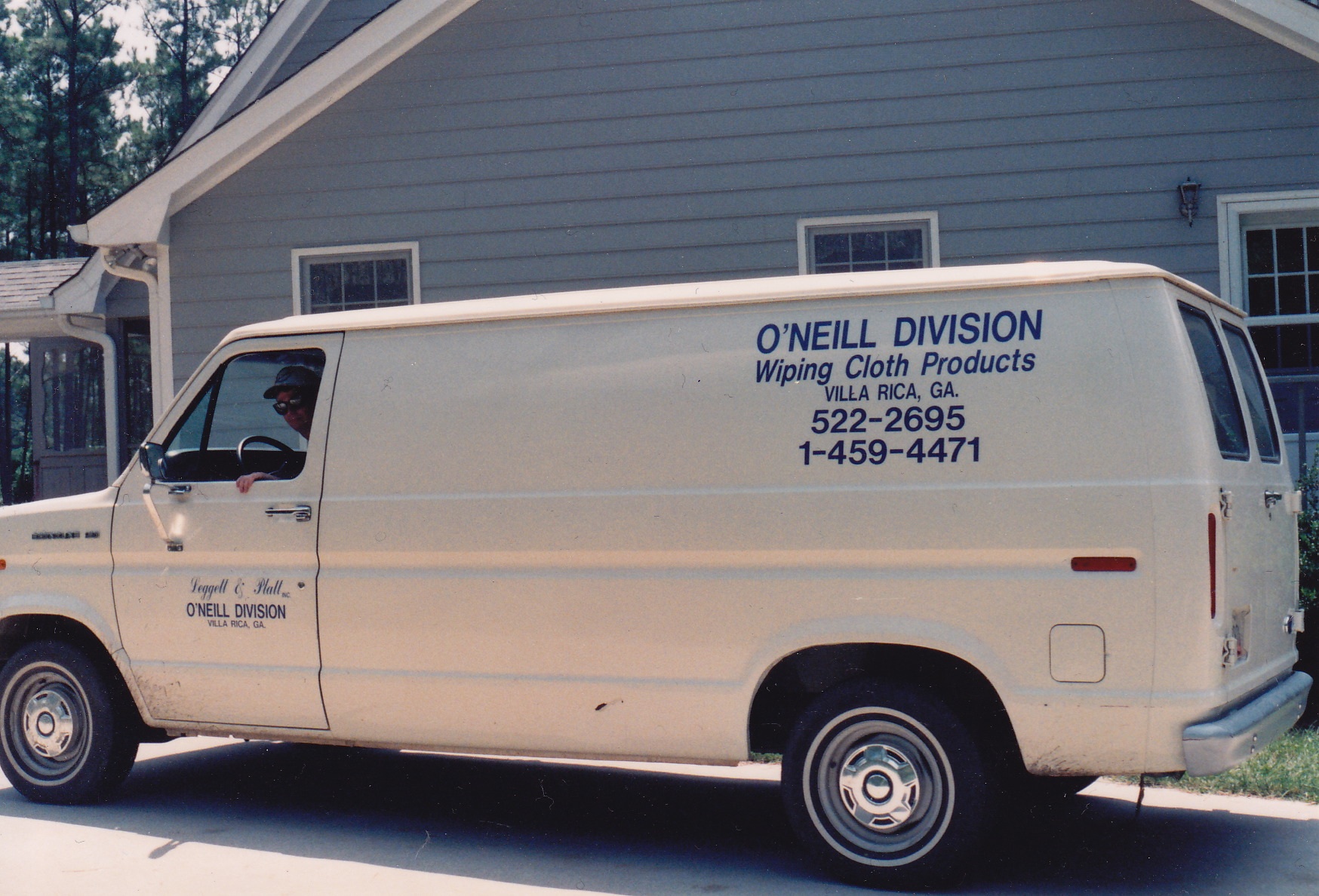
My first job?  I did some grass cutting in the neighborhood but what sticks out is the time working for Leggett & Platt in their Georgia operations.  My Dad led a business unit and my brother and I worked summers doing a variety of odd jobs around a textile mill and operations (also one Christmas break when I needed new tires for my car).  I worked with some amazing, hard working, and genuinely decent people.  Some were brilliant and others couldn't read but were brilliant in their ability to fix just about anything.

Unlike many of my peers at this stage of my life, I have worked on a shipping dock, driven a fork lift, cleaned up untold amounts of garbage, textile debris, hydraulic oil and other identified things.  This doesn't make be better than anyone, just different.  I understand distribution because I have gotten dirty doing it – not just writing it on a Powerpoint slide or saying it.

The pictures here are of me when I was 18 or 19 and had responsibility for making deliveries of industrial wiping products – rags.  Big and durable ones.  The kind that are used to clean wheel axles or drill bits or just about anything else.  I delivered 25 and 50 pound boxes just about everywhere.  I got lost a lot and had my fair share of harrowing experiences jockeying for a slot at a receiving dock with trucks much, much larger than me.  This was a major step up in responsibility and type of work after many summers in the shop and on the floor…and when there were no deliveries to be made I was right back there.  As you can imagine, I was always working hard to make sure there were deliveries…

RCP_LP_vanfull

What was your first job and what did you learn that you apply everday?  Share it with me and I'll post it here.


It’s not just about the technology

I have been wanting to create an animated video with Xtranormal for some time and finally got around to trying one out.  This is a really easy and clever way to produce animated clips with a script you write.  It is still a bit clunky in translation but that adds to the entertainment. 

Here's mine on the startup sales pitch to a business focusing on how it works vs. what it does and value delivered. 


This technology will only improve as time goes on making creating something like this easy for anyone and the end product polished like it was done by a professional.

My presentation to the University of Washington Entrepreneurial Strategy class tonight

I was very pleased to have friend and UW MBA student Max Effgen invite me to present to Dr. Jon Down's Entrepreneurial Strategy 510 class tonight.  I enjoyed great questions from smart people and Dr. Down was an amazing host.

I attempted to take a "lessons learned" approach in the presentation with an emphasis on getting started.  There are many business plans that never make it to step one of implmentation (including many of my own) and there is something to be said for just starting.

Here's my presentation which combines those lessons learned and an overview of Gist to reinforce and highlight much of the first part.  Enjoy!


Putting political attack ads in historical context

The volume and rhetoric is going full speed as we stumble towards election day.  As the attacks become more personal between candidates and the accusations more absurd – both direct and coordinated via interest groups and interested "media," there is a great deal of discussion about how nasty things have become and how we need to return to civility.

Think it really use to be more dignified and kind?  Thank again.  Although broadcast TV, cable "news," and Internet communciations seriously amplify it, the rhetoric and venom that has flown through campaigns in the past is epic.  Check this well done video that highlights the election of 1800 – Thomas Jefferson vs. John Adams.  This was a sitting Vice President running against the sitting President.  Think about that scenario today…


Four steps to getting started with social media

Agent Reboot Logo

I had the opportunity to be part of a panel discussion on social media at the most recent Agent Reboot event in Washington, DC.  It was great to be back to a place I lived for several years "back in the 90s."  Lots of familiar places and was able to reconnect with some friends while I was in town.

I framed my comments at the event to take a step way, way back from the hype and excitement around social media and explain what it is and that everybody can, and already does, do it.  Learning all the tools, tricks, and tips is another issue but there really is very little mystery surrounding it.

Here's why:

Fundamentally social media is about communicating with people.  Something we all know how to do and do every day in a variety of ways – meetings, phone calls, emails, etc.  The "social" piece of it focuses on participation.

More people from more places can come together and share, interact, and get updated all at one time or, more importantly, on their time complete with links, pictures, and a threaded view among other things. 

I suggested the following four steps to get started and this has been a recurring theme of ours in all of our presentations.

1.  Listen

You don't have to have anxiety about your writing, if you can be witty, or even spell correctly.  Start out by reading what others are sharing.  There is probably already somebody in your neighborhood doing this.  In Kirkland, WA (where I live) there are two local blogs I read that keep me informed about what is going on in my community – Kirkland Weblog and Kirkland Views.  Beyond where you live, find others writing about your interests, skills, or hobbies.  It is really easy to use Google to find these types of bloggers and you can also use Twitter search.

2.  Share

Now that you are reading interesting things by people in your neighborhood or written about your interests, you will no doubt want to share those with others.  Enter email.  Copy a link and paste it into the body of an email or share it directly via email from the post. You'll probably even add a bit of commentary on it as you share with friends or co-workers. Congratulations, you have now shared content. 

3. Comment

Now it is time to come out of the shadows and share some of that commentary you are adding to the emails with the world.  Read a post and comment directly on it.  The comments on a blog, especially a heavily trafficked one, are where the real conversation and insight unfolds.  Remember, do not self-promote.  Add something of value to the discussion…like you would if you were talking to a group of friends at a coffee shop.

4.  Contribute

If you have made it this far and really want to strike out on your own by publishing yourself, you have a variety of choices to make about tools, costs, time commitment, etc.  The tools are cheap, easy to learn, and just put yourself on a schedule to write a blog post a week.  Carry a notebook and write down random thoughts.  If you find yourself answering the same questions over and over for friends or co-workers, write a post and share that link next time (see #2 above).  Simplify your broadcasting by linking your blog to Twitter to Facebook to LinkedIn.  Or don't and control it.  It is your call and you are in control.

Even if you never move past Step 1 you will be better informed in your job or even at your next cookout