More on selling software

Great friend (and mentor) Jim Clifton has a nice post up about the disappointment he sees in software as a product.  Jim gave me my first software product management job and has a broad perspective on the topic having built software, funded new ventures, and now consumed it as a small business.

I couldn't agree more that the most important thing to understand is the broader process you are either enabling or disrupting.  If you (or your sales team) lack the domain or business process understanding, you will have lots of first meetings and very few next ones.

Adding sales people does not always add sales

One of the companies that I am working with is confronting this reality head on.  Every start-up I have been a part of has learned the lesson (the hard way) that staffing up with a large national (and many times mediocre) sales team for an emerging technology company is a recipe for disaster.  Here's my previous post on Being Intellectually Invested that touches on this. 

Why is this?  I suppose it seems like the right thing to do and I have consistently found investors drive this thinking.  After all, "how hard can it be, pick up the phone and sell."

Here's the challenge: if the company does not understand its product/service within the context of the market and market needs, this approach will fail.  Sales reps will be terminated, soon the pressure is on both the VP Sales and VP Marketing to explain the poor performance, and both will go before the CEO gets the pressure from the investors and is shown the door. 

These cycles of usually good people are expensive, an organizational distraction, and build absolutely no comfort with those to whom you are trying to sell. 

While it may seem counter-intuitive to have fewer rather than more dedicated sales people early in a company's lifecycle, the true cost of adding and losing sales professionals before the company has really figured out how to sell is much more significant than any "lost" sales because of fewer feet on the street.

Once the sales path (or model) is understood, then it's time to spend some bucks on a process and metrics driven VP of Sales and quota bearing sales reps (QBSRs).


 

Words of ‘wisdom’

Last Friday I had the opportunity to speak to a handful of 1st year MBA students from UW's Foster School of Business.  I was one of several people who spent a bit of time with this great group and wanted to share what I shared with them as it relates to my key takeaways from business school:

  • No one is going to hire you to be CEO even though that is what business school teaches you.  Set yourself apart by understanding the CEOs perspective while executing your job responsibilities.
  • Learning how to manage and interact with people is critically important so don't dismiss those organizational dynamics classes.  You can't do it all yourself and knowing how to lead will set you apart.
  • Learn how to sell and be comfortable doing so.  Whether you are selling an idea internally or selling a new product to the market, learning the patience and discipline of this process is essential.  
  • Concentrate on analytical frameworks and quantitative approaches.  No one is going to ask you the R-squared of anything, but having a command and comfort with quantitative analysis is very important.
  • Where you went to business school matters until you achieve something new – this is the beginning, not end of your achievements.  Avoid those that point exclusively to their MBA as proof of their value.
  • You create your own opportunities.  Seek out others to learn from and cultivate leadership qualities in those you manage.
  • Please, don't take yourself too seriously.

I think there were a few others but I seem to have misplaced the post it note where I had jotted down my thoughts during lunch.

All I need is a blog and a Twitter account

This is a fascinating post in which CPA Scot Justice (The Virtual CFO) talks about his blog and Twitter usage as marketing tools stating that 75% of his business comes from these efforts.  Bill Seaver of Nashville-based MicroExplosion Media made this cool video and great to see this type of thing coming from Nashville (where I was born and mostly grew up). 

The true test of any technology or innovation is its application to the mainstream or practical users.  Scot is definitely on the front end of the curve but the adoption of these tools by a CPA who is himself a small business is an indication of things to come.

The rules of marketing are definitely changing as are the costs to reach and engage customers.  The bar is much higher so if you don't have the expertise or lack authenticity you'll be found out quickly and treated without mercy.

Brad Feld in Seattle Feb 25 – put it on your calendar

I have yet to meet Brad in person but have corresponded with him and met some of the team at the Foundry Group.  I am a bit of a Boulder fan boy and the combination of technology, venture capital, start ups, and Boulder has made me a long time reader of Brad's blog.

Brad's coming to town on Wednesday February 25th from 6pm to 8:30pm at the Palace Ballroom at 2100 5th Avenue in SeattleHere's his post on it.

Good friend TA McCann of Gist (where I am helping out a bit) as well as Dave Schappell of TeachStreet have pulled together what looks to be a great event with the $5.99 admission going to Seattle micro-finance non-profit Vittana.

I have a conflict that evening but am sure it will be a good time with some great folks.

Well this certainly clears things up

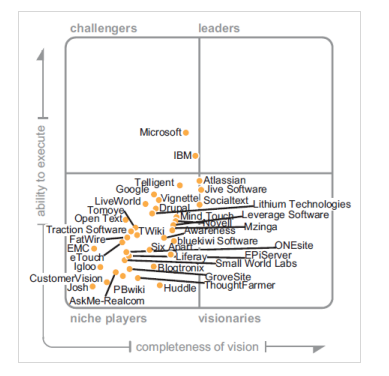
Gartner Group released their Magic Quadrant for Social Software towards the end of last year and I came across it today while doing some research.  It was great to see cool company Socialtext featured in the analysis although that is a bit hard to determine when you look at the quadrant itself.  Guess it's fair to say there are no true leaders in this market yet but definitely plenty of players.  Think they could have crammed any more companies in the bottom left?

Picture 2