More cedar plank salmon & memories of New Zealand

It is always fascinating to watch which of my posts generate the most organic search traffic (meaning people are looking for stuff on their favorite search engine and find my posts).  Interestingly, near the top of that list is a post some time ago about cedar plank salmon.  Due to its popularity and my affection for eating it, I thought I'd share a picture from last night's smokey but delicious menu.

DSCF0010

I am continuing to evolve both my technique and recipe.  As you can see from the picture, I have taken to a layering strategy for the cedar where I use previous planks on the left and right and then place a new plank over the top.  Middle burner is off and left/right ones are low enough to smoke but not catch fire, mostly.  I suggest a bit of water nearby to keep the flames down.

My recipe has evolved a bit as well.  I do not measure when I cook so you'll have to figure that out on your own.  Here's what I used last night:

  • Light brown sugar
  • Soy sauce
  • Bourbon (splash)
  • Cayenne pepper (sparingly)
  • Chopped fresh thyme
  • Salt
  • Pepper

The result was outstanding and the smoke was plentiful.  While sitting down to eat it on a chilly June evening here in Seattle, I couldn't help but think about one of the most memorable dining experiences I ever had where smoked fish was the theme.  Many years ago, Marel & I took an extended trip to New Zealand & Australia and happened across The Smokehouse in Mapua, New Zealand after the recommendation of our kayaking guide.  The place was unbelievably cool and the food amazing.  If you find yourself around Nelson, check it out.
Building a listening framework

This two part post is about "listening" to what is being said on-line and the more complicated aspects of acting on something once you've heard it. I'll focus on listening first and will follow up with one on action & engagement here shortly.

So, what the heck am I talking about? You may be aware of this thing called the Internet and there are a lot of people on it. Not only are they consuming content, they are creating content with increasing frequency and ease. Yes, this includes Twitter, blogs, blog comments, and everything in between.

It sounds a bit trite at this point but there really is a conversation going on and you need to be listening to it in some way as part of your marketing efforts. It's not just about your product or brand but about what people need, what they are unhappy with, where your competitors are falling down, where a new entrant is eating you alive, or where one hater has decided to make it their mission in life to bring your product or service to its knees.

All of this plays out every minute of every day in as little as 140 characters in a Twitter status update.

A note of caution – it is loud so be prepared to turn the volume down a bit with tools, process and methodology.

Here is what I use and what I would recommend using as a starting point. I am sure there are other tools & techniques including one that might do all of this in one product. If it exists, please let me know.

  1. Identify 'where' you'd like to listen – Twitter chatter, Linkedin Questions, news outlets, competitor's websites, blogs, blog comments, etc. I'd suggest anywhere you can although you will get some overlap.

  2. Identify what you are going to listen for – keywords can create huge false positives especially if it is a frequently used word….like 'Gist.' One note here is that although unique names are easier for you to listen for, it is also easier for your competitors to keep tabs on you so keep that in mind during your next branding/naming session.
  3. An RSS reader is your key interface (I use Google Reader)
  4. Use Twitter Search to build searches on Twitter content and select "Feed for this query" in the upper left and drop it into your preferred RSS reader
  5. Use Google Alerts and select to receive these keyword alerts as RSS feeds
  6. Use BackType to monitor blog commenting content and enter search terms as above one by one and select Feeds->Search Results
  7. Use Digg and search for keywords/themes then subscribe to these results as a feed

Also, check out Tweetdeck to watch Twitter posts (you can set up search terms in this app by clicking on the magnifying glass in the upper right).  The benefit of Tweetdeck is the ability to act on what you have heard by replying publicly, replying privately, or "retweeting" (sharing) someone's post.  More on action and engagement coming shortly.

This framework should give you pretty complete coverage of the on-line conversation and is a must have in any marketing plan.

Life experiences – Washington, DC

I'm a big believer in life experiences especially when they can be mixed with a bit of business.  Last week while in Washington, DC I was fortunate for two reasons:

1. I was able to spend a couple days with friends that I hadn't seen in a long while
2. I was able to experience the nation's capitol on a whole new level

One of my friends is Chief of Staff for a US Senator (there are only 100 so see if you can figure it out) and extended an invitation to have us join them for lunch in the Senate Dining room.  This kicked off a day that included meeting lots of great people and seeing more Senators than I ever had before (I am a bit of a closet political junkie).  We also were fortunate to walk on to the floor of the US House of Representatives thanks to a generous Congressman (435 of them – good luck). 

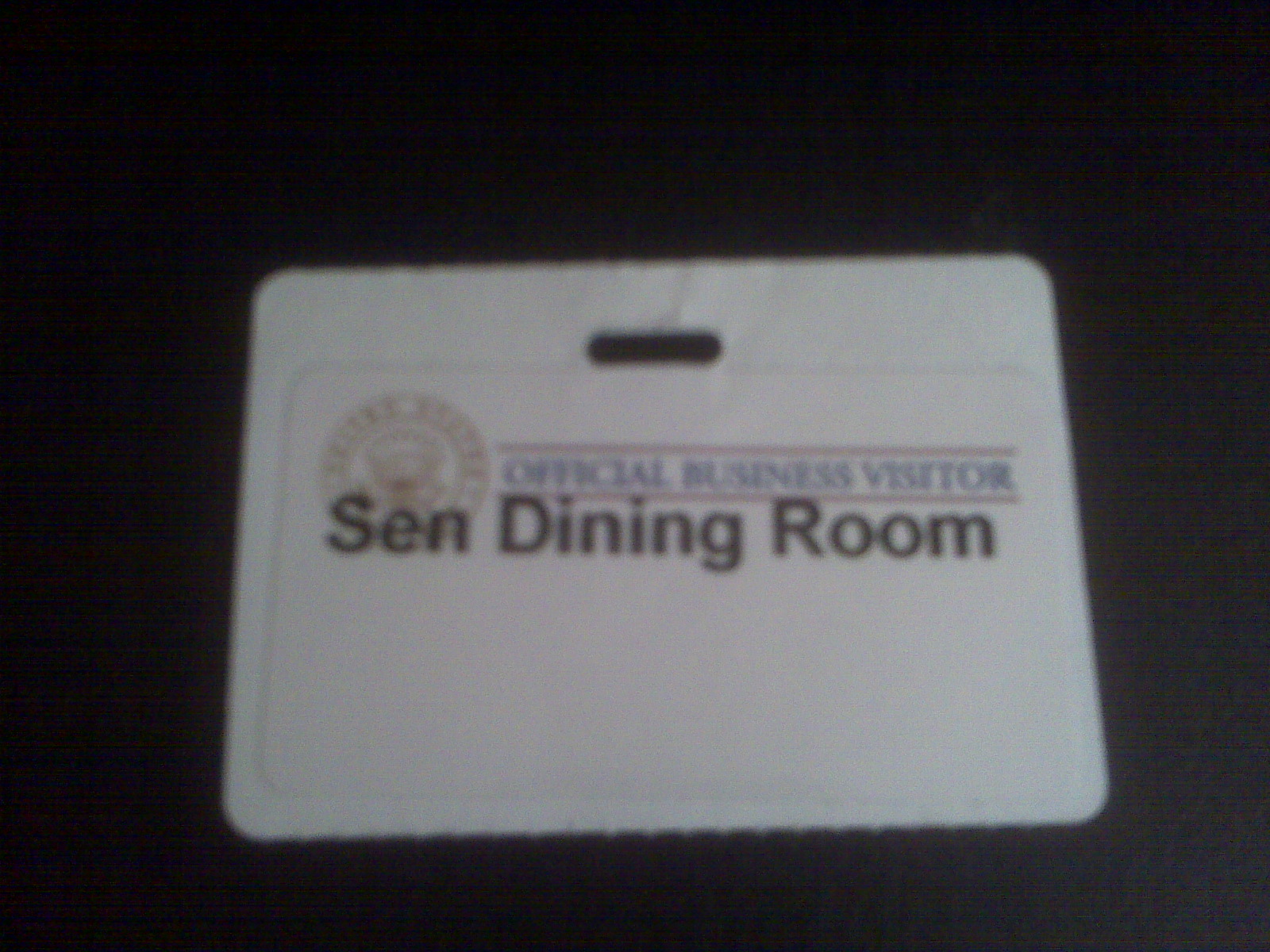
Here's my badge from lunch and a bit of video from the ride on the "train" from the Russell Senate Office Building to the US Capitol.
USSenate_diningroom  

I love Washington, DC and lived there for almost 5 years.  A couple of morning runs on the National Mall as well as connecting with both previous co-workers from my Arthur Andersen days and new friends from current projects made for a great couple days.

No more product beta – it’s all about market beta

Google has, more than any company, made the beta label on a software product meaningless and is learning that their enterprise aspirations don't jive with having a product like Gmail in "beta" for five years.  Enterprise customers don't want the SLA to be based on that fact that "stuff will happen because it's a beta product."

I'm not saying that you shouldn't pursue a pre-commercial product launch strategy that puts your product in the hands of as many possible target users as possible.  Releasing early and often with actual user feedback is an essential component of building and launching a new product.  Understand that the bar is high as the expectation on "beta" is high these days for the previous stated reason but don't let that distract you.

What really resonated with me last week at the WTIA's Fast Pitch Forum was when Socrata (formerly blist) CEO Kevin Merritt described the beta process as being less about product and more about market these days.  They had their product and brand out there (essentially a database app in the cloud) and the market gave them guidance on how to better position it (sharing data with a focus on government transparency).

Building on Kevin's thoughts, it struck me that the on-demand tools and infrastructure available now make it easier than ever to get something "out there."  The process then is less about the functioning product but more about how you align your product concept and the features you are building with a market – product/market fit.  This requires a vigilant process of creating market hypotheses and testing the heck out of them – "salespeople do x and use y so therefore would find value in my product." 

You can only validate the hypothesis above if you take a methodical approach to putting your product in the hands of a salesperson and seeing if your perceived need is indeed actual need and is the source of realized pain vs. latent. 

You may very well be wrong…but that's ok.  It's beta..

Learned a few things last night at the Pugest Sound AMA Eastside event

I was happy to get an invite from a good friend to attend this event last night in Bellevue.  The speaker was Michael Hilton who is EVP of Marketing at Concur and was the company's founding CEO.  Concur is a great company here in the Seattle area that provides enterprise expense management software and, more interestingly, made the transition from premise-based, perpetual software licenses to SaaS, subsricption-based licenses and lived to tell the tale (although they certainly took their lumps along the way).

Michael and I chatted briefly before the event about the evolution of enteprise marketing strategies and if all the social media hoopla (my word) can lead to measurable results and booked new revenue.  I think we both agreed that you have to be doing something with it and Concur has made it part of their overall marketing mix.

During the presentation, Michael shared some great insights with the group and I wanted to share a few of the highlights:

  • Search is the awareness king and their #1 source of leads that lead to new business.  They derive about 2/3 of their traffic from natural vs. paid search
  • In 2009, they are 100% on-line for ad spend (no more print advertising).
  • They measure their marketing success based on "qualified leads" generated and Sales applies this label based on a defined acceptance criteria
  • Big users of webinars preferring scheduled events vs. on-demand content
  • Experimenting with Twitter, Facebook, & LinkedIn
  • Doing some really cool things around enabling customer communities and allowing customers to provide feature suggestions and vote on their importance as a community.

Tell me your phone number twice in a voice mail

Please. 

If you are leaving it, you want me to call you back.  In order to call you back, I need to capture the phone number and it takes several extra steps on my end to find it in my contacts if you are there at all. 

Oh, and yes, people still do use the voice calling features on their phones to communicate.

As I am not blessed with a brain that captures and catalogs all information heard once for instant retrieval, I am going to need to write it down.  I may get all the digits but want to make sure so repeating it for me again slowly will ensure I will call you back quickly and keeps me from having to listen to the entire voice mail again to get the number, hopefully.  This is especially true if you are not someone with whom I regularly communicate (ie, not in my contacts/saved numbers).

I always do this because I want to make it as easy as possible for people to call me back.  Try it out and see what you think especially if you are leaving a voice mail for me.

Gist at the WTIA Fast Pitch Forum

Here's some nice video of Gist founder & CEO T.A. McCann at today's WTIA Fast Pitch Forum.  I attended this event several years ago and it is a good place to connect with both investors and entrepreneurs here in Seattle.  I missed Tim Draper's song at lunch due to a conference call but hear it was "interesting."

http://www.ustream.tv/flash/video/1568210

Q&A is towards the end with a nice opening question from Rob Adams, Sr. Director of Corporate Development at Cisco Systems, about how Gist compares with Xobni.  He issued the proper disclaimer that they are an investor and I thought TA's answer was spot on about the differences in Gist and Xobni.

Other highlights of the day included some cool presentations, meeting new people, and seeing some great early stage companies from here in Seattle.

Headed to the WTIA Fast Pitch Forum tomorrow

I'll be down at the Bell Harbor Conference Center for a bit tomorrow for the WTIA's Fast Pitch ForumGist is on the agenda mid-morning and there are lots of great companies lined up to do (very) short presentations.  If you are going to be around and would like to connect, let me know – robertcpease at gmail dot com or twitter.com/replytoall.  I'll try to share some highlights from the sessions while I'm there.

Is your sales pipeline lying to you?

If you look at your sales pipeline right now, can you count at least one huge deal that has been there a long time and promises to be the game changer/make your year/validate your business event?

Most sales pipelines (especially those from early stage companies) have at least one large 'deal' that sits there.  The reasons are many and predictable – have not received a yes or no, wants to meet again, still looking for who has budget, project owner changed, re-prioritizing projects due to budget constraints, gone silent, etc.

The bigger the deal, the more important to you, and the longer it sits in the pipeline as a whale but not making any real movement means it will not happen in a time frame that is meaningful to you – this quarter, this year, before funding, etc.  That doesn't mean it won't happen.  It just means it will come together when it comes together if at all.

Chase big deals but be disciplined about measuring progress including having clearly understood desired end states at each step in the sales cycle that signify meaningful progress versus more meetings and email exchanges that provide limited clarity.  Mostly, and it sounds corny, don't put all your eggs in one basket as it rarely works out when and how you imagine.

The 255 is my new best friend

I have been taking the bus back and forth to Seattle from Kirkland the past several weeks as I am spending more time down at Gist these days.  The 255 bus literally picks up about 50 yards from my house and takes the same route downtown that I drive so really no excuse not to take it.

I am mildly ashamed that it has taken me a couple years to actually give it a go and have embraced my rookie status as I learn the ins and outs of when the fare changes, why the bus stops some places and not others, what to do when the downtown bus tunnel is closed, and the best time to pull the cord to signal you want to get off (not too early!).  I have learned all these lessons over the past several weeks and am sure I provided a bit of comic relief to all the hardened veterans on the 255.

It's a nice ride, clean buses, good people, and a bit of prep time in the morning and decompression time in the afternoon.