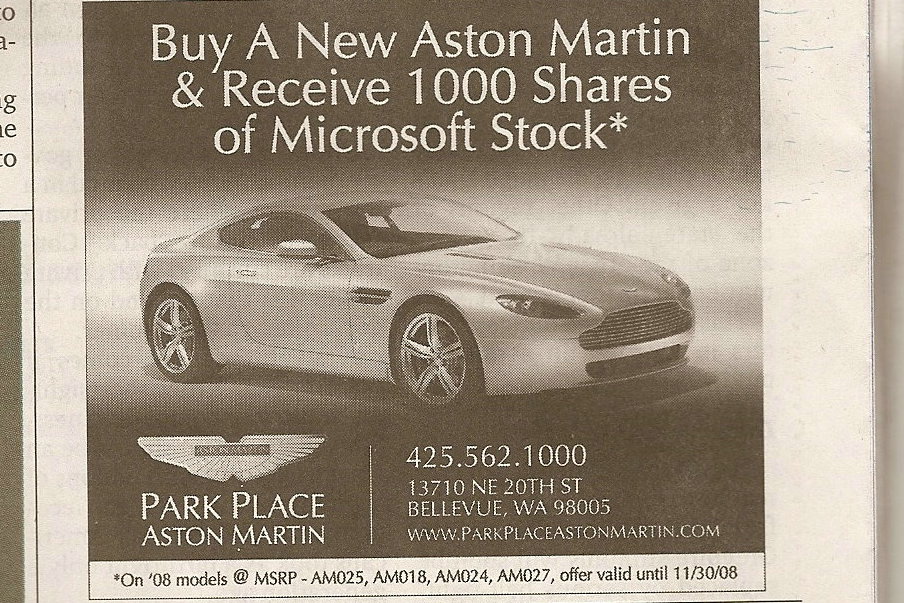
If you can afford an Aston Martin, do you really need Msft stock?

I get one paper – The Sunday Seattle Times.  Even though we have no shortage of on-line/real-time news feeds these days, I still enjoy thumbing through the paper on Sunday morning with a cup of coffee.  Call me old fashioned.

Anyway, the ad below caught my eye today (on the back of the business section) and wanted to share it here.  It definitely hits on Marketing 101 concepts of promoting with an offer (buy car, get stock) but I found it being applied to an Aston Martin purchase a bit interesting.

I love these cars and if I ever have the means, I will own one.  Unfortunately, I am not in a position to take advantage of this offer.  Maybe you are so give them a call.  I'm sure they'd love to hear from you.

Aston

Last slide first

There were lots of great presentations at the SIIA On-Demand conference in San Jose this week and I'll be posting some thoughts about what I learned over the next few days.

One of the highlights was a presentation by NetSuite CEO Zach Nelson and his first (and last) slide.  He told a short story about this being the way to do a presentation from his early working days at Motorola.  The then Vice Chairman (missed the name) told him to skip all his foils (pre-Powerpoint, egad!) and put up the last one.

We have all gotten away from this with too much Powerpoint in our lives and I promise I will now start all my presentations with the last slide. 

Life event

Took a bit of a blogging hiatus to welcome the newest member of our family to the world.  We are now the proud parents of another little girl.  She joined us Friday and everyone is doing well.  Getting reconnected and caught up so will resume posting shortly.

A true picture of GDP growth

I thought this was an interesting image (via Paul Kedrosky) showing historical GDP growth with and without mortgage equity withdrawals (MEW).  Makes the last 7 or 8 years look pretty artificial in terms of real growth but maybe was initially necessary to get us through the last downturn and subsequent economic impact of 9/11.  Like all things taken to excess, there is a price to be paid and we need to focus on real GDP growth going forward.

GDP

No instant replay in election of US President

After being bombarded with all sorts of official and unofficial 'news' about the race to be the next President of the United States this evening as I sifted through my RSS feeds, a few things occurred to me. 

1. Each candidate (and their surrogates) has their version of events, why they are better, why the other one is worse, and the way forward for America.  I subscribe to both candidates' blogs (Obama & McCain) and suggest you do as well if you have a tolerance for spin and marketing (an election is, after all, a marketing campaign).  Also tap into Politico for some perspective.

2. Much like when a close (or not so close) play happens in a football game and all the fans both at home and in the stands see it through their team preference, the same is happening and will happen this election.  One person's down by contact is another person's fumble.

3. In the closing weeks of this election, the rhetoric and nastiness will intensify.  After all, this is a pretty significant job and the winner commands a great deal of power.  The good news is that the Obama campaign will probably single handily stave off a recession in the advertising market as they put their cash hoard to work.

In a football game, the fans boo and then go back to watching the game convinced they saw it better than the guys on the field and the review team in the replay booth – but the final call is the final call.  In this election, there will definitely be some booing by the defeated team and, unfortunately, we have no replay booth. 

Just a Constitution, a process, and our optimism (I hope) as a country.  I think this is closer than the "polls" indicate and we need to be prepared for that reality as a country.  Surveys, polls, and numbers are suspect things but are useful tools in a marketing campaign (see point #1 above).  If you read one, consider the source, look at the sample, and use it as one of many data points over time.  I still remember the 2000 election and seeing the aforementioned pieces actually work (in a bar in Boston believe it or not) as well as the US population getting an eduction on what the electoral college was all about.  One side won and one side lost, but the process works.
10 Things That Will Change

Kiplinger's Personal Finance
is the only print magazine I subscribe to because I like the absence of
"get rich" stories featured in other money pubs and the focus on
personal investments.  It's not expensive and reading it will do
wonders for your financial security. 

This is a great list of items from them on what we can expect the regulatory and financial climate to look like going forward.  As the article points out, most of this will be familiar as everything old is new again.

"In reality, the change isn't to a new environment. It's a return to
traditional norms of the past, before cheap money inflated asset
values, undermined lending standards and encouraged excess risk. It's
bitter medicine, but it's necessary."


Amen.