First Job – Michael Barry

I received some great feedback on my First Job post and appreciate the kind words.  Glad I was able to take a few folks for a trip down memory lane.  I was fortunate to receive a few first job stories that I will share over the next few days.  If you have one you'd like me to share, please send it along and I'll post it.

The first one is from Michael Barry, one of the best friends I have and a fabulous attorney who lives in Atlanta.  Here's his bio and you can follow him on Twitter here.
From Michael: 
"Delivering a weekly neighborhood newspaper in Defiance Ohio. I was 9 or 10 at the time and recall having the stack (seemed like 1,000s, but am sure it was only 50 or 70) dropping off at my house on Sundays and spending Sunday afternoons bundling the papers with rubber bands and then putting them into plastic sleeves to hang on the doors.  I had my bicyle rigged with various bags so I would not have to circle back home more than once to re-fill. The hardest part of the job? Customer service.  We were required to hang the papers on the front doors, not just toss them into the yard. It was a pain – starting and stopping at every house – but I learned later that my neighbors appreciated my attention to that detail. When we moved and I had to give up the route, my replacement just tossed it into the yard and never hung the papers on the door. (And boy did the neighbors complain!) A reminder that its often the details that set us apart. Some things never change.
 
I was saving $$ to buy a new bike. A huffy dirt bike. It was awesome."

Thanks for sharing this Michael!

First Job

  RCP_LP_van

What was your first job?  The first thing you ever got paid for when you were a teenager?  You probably haven't thought about it in a long time so take a moment and think back to the first time someone paid you for doing something.  Cutting grass, flipping burgers, babysitting, or the like?

The truth is we all had a first job at some point in our lives and that first job is a critical piece to what makes us tick.  How?  The lessons learned, experiences gained, and ability to apply what on the surface seem like unrelated experiences is unmistakeably telling about someone as you evaluate them for a job, promotion, vote, award, etc.

One of my long time favorite intervew questions is to ask this.  It takes the interview beyond a resume and business environment (in my case) and puts it into an unexpected place for the person being interviewed.  I am no longer asking about the amazing accomplishments they are representing, I am now asking about something from their youth that they were unprepared to discuss and probably hadn't thought about for a very, very long time.  Thus, you get to the real person.

I have heard stories about everything from fast food and lifeguarding to detasseling corn and working in a funeral home.

The answer of what is not as important as the second part of the question – what did you learn from that experience that you apply every day today?

I have seen people completely freeze on this question which shows a lack of critical thinking and creativity.  I have heard some arrogant and unfortunate things like how stupid co-workers were or how demeaning the work was as well.

The ones I like the most hit on work ethic, accountability, and learning.  Those are the people I want on my side.

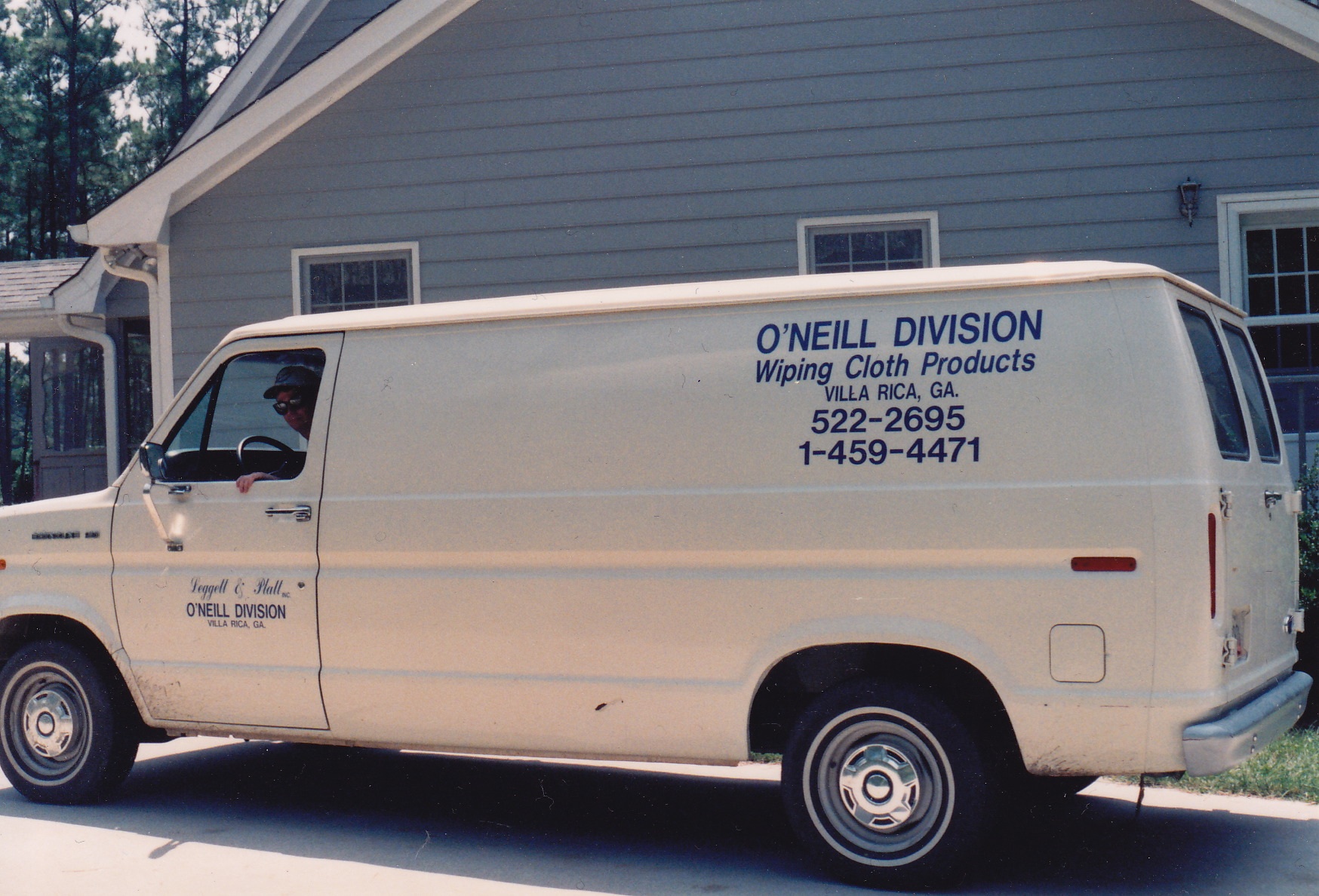
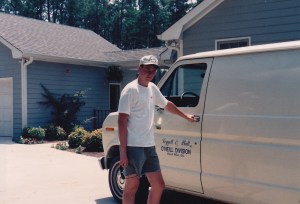
My first job?  I did some grass cutting in the neighborhood but what sticks out is the time working for Leggett & Platt in their Georgia operations.  My Dad led a business unit and my brother and I worked summers doing a variety of odd jobs around a textile mill and operations (also one Christmas break when I needed new tires for my car).  I worked with some amazing, hard working, and genuinely decent people.  Some were brilliant and others couldn't read but were brilliant in their ability to fix just about anything.

Unlike many of my peers at this stage of my life, I have worked on a shipping dock, driven a fork lift, cleaned up untold amounts of garbage, textile debris, hydraulic oil and other identified things.  This doesn't make be better than anyone, just different.  I understand distribution because I have gotten dirty doing it – not just writing it on a Powerpoint slide or saying it.

The pictures here are of me when I was 18 or 19 and had responsibility for making deliveries of industrial wiping products – rags.  Big and durable ones.  The kind that are used to clean wheel axles or drill bits or just about anything else.  I delivered 25 and 50 pound boxes just about everywhere.  I got lost a lot and had my fair share of harrowing experiences jockeying for a slot at a receiving dock with trucks much, much larger than me.  This was a major step up in responsibility and type of work after many summers in the shop and on the floor…and when there were no deliveries to be made I was right back there.  As you can imagine, I was always working hard to make sure there were deliveries…

RCP_LP_vanfull

What was your first job and what did you learn that you apply everday?  Share it with me and I'll post it here.


Having the courage to try

What do you do when a problem arises or a situation occurs that needs immediate action even though that action may not be completely thought through and the problem/situation may be less than defined?  Do you have the courage to try or do you wait for others to try and comfortably critique once you have seen the outcome?

Make a point to have the courage to try and own the result.  If you are one of those who rests comfortably on the sidelines while others try, you are only showing your cowardice and wasting your creativity. 

This hits at one of my management philosophies about not stating a problem without a suggested solution AND being prepared to own it…otherwise, don't bring it up.

Something to think about….

I promise to return more actively to blogging.  Been way busy and the sun is finally out in Seattle making 140 character updates via Twitter preferred.  You can follow me there @ReplyToAll.

Words of ‘wisdom’

Last Friday I had the opportunity to speak to a handful of 1st year MBA students from UW's Foster School of Business.  I was one of several people who spent a bit of time with this great group and wanted to share what I shared with them as it relates to my key takeaways from business school:

  • No one is going to hire you to be CEO even though that is what business school teaches you.  Set yourself apart by understanding the CEOs perspective while executing your job responsibilities.
  • Learning how to manage and interact with people is critically important so don't dismiss those organizational dynamics classes.  You can't do it all yourself and knowing how to lead will set you apart.
  • Learn how to sell and be comfortable doing so.  Whether you are selling an idea internally or selling a new product to the market, learning the patience and discipline of this process is essential.  
  • Concentrate on analytical frameworks and quantitative approaches.  No one is going to ask you the R-squared of anything, but having a command and comfort with quantitative analysis is very important.
  • Where you went to business school matters until you achieve something new – this is the beginning, not end of your achievements.  Avoid those that point exclusively to their MBA as proof of their value.
  • You create your own opportunities.  Seek out others to learn from and cultivate leadership qualities in those you manage.
  • Please, don't take yourself too seriously.

I think there were a few others but I seem to have misplaced the post it note where I had jotted down my thoughts during lunch.

People respond to what you inspect

I heard this in a presentation some time ago and believe it was credited to Louis Gerstner of IBM fame.  I think it is a great quote and one worthy of remembering. 

Regardless of your job or role, what you measure and how you hold those accountable to what you measure will influence their behavior.  The important thing to do is to make sure the metrics and measures you are using are the right ones.  Number of calls made, site traffic, expenses, time in the office, leads generated, proposals sent, amount of time to follow up on a lead, etc. will influence how people work and what they prioritize. 

Be sure to inspect but make sure you inspect the right things.

Steve Jobs on being laid off

I came across this some time ago (via Sramana Mitra) and thought it was a good read and great perspective.  This is taken from a 2005 Steve Jobs commencement address at Stanford.  Here's a couple of quotes that I thought were share worthy given lots of news of layoffs these days:

"I didn’t see it then, but it turned out that getting fired from Apple
was the best thing that could have ever happened to me. The heaviness
of being successful was replaced by the lightness of being a beginner
again, less sure about everything. It freed me to enter one of the most
creative periods of my life."

And this one…

"Your work is going to fill a large part of your life, and the only way
to be truly satisfied is to do what you believe is great work. And the
only way to do great work is to love what you do. If you haven’t found
it yet, keep looking. Don’t settle. As with all matters of the heart,
you’ll know when you find it. And, like any great relationship, it just
gets better and better as the years roll on. So keep looking until you
find it. Don’t settle."

One of my favorite words

Tenacious.

This word has been used to describe me in the past and while it may be a euphemism for other less flattering adjectives, I'll gladly take the label.
 

Merriam-Webster's definition of tenacious:  persistent in maintaining, adhering to, or seeking something valued or desired

Will Price posted on tenacity today highlighting the ups and (mostly) downs of Abraham LIncoln's career. 

Look no further for inspiration and be comfortable knowing you must fail to ultimately succeed.

Transparency

I am a huge advocate of transparency both across functional areas as well as within my team and try to share everything I possibly can as soon as I can.  Sharing information vs. hoarding it is a key foundation of leadership and indicative of someone's comfort in their role and position.

I have read a handful of John Maxwell's books on leadership including The 21 Irrefutable Laws of Leadership and agree that part of a leader's job is to replace themselves by providing those they lead with opportunity.  If you can do my job, then I am able to go and do another job.  This is not intuitive to most folks.

There are, of course, some things that must not be widely shared but calling out in advance that the goal is to share any and all information is key to effective leadership. 

It is, however, important to consider if all members of your team are ready for this type of transparency and can handle the information you are sharing.  Part of it is how it is packaged and presented although I have learned the hard way that this policy can cause angst and, in some cases, departures.  So be it as you want to surround yourself with those that are up for a challenge and will do whatever it takes to succeed.

A great conversation with Jamie Dimon of JP Morgan Chase

This is a really great conversation between JP Morgan Chase CEO Jamie Dimon and Charlie Rose.  In addition to the notion of keeping an owe you/owe me list on you at all times, here’s a few quotes I like from the chat:

“history may not repeat but it rhymes”

“buying a house and buying a house on fire are two different things” (about Bear Stearns purchase)

The “owe list” is something he keeps in his pocket.  If he has a conversation and someone owes him something as a follow-up, he writes it down and same goes if he owes somebody something (a call, etc.).  Interesting approach and unique way to stay focused on getting things done and holding people accountable.

Below is a snippet from Youtube and a link to the entire discussion is here (via Paul Kedrosky).