Building systems of engagement for the social customer

Paul Greenberg is a wicked smart guy and does an awesome job laying out the definition and rules of engagement for the "social customer." He does a great job of articulating what we are working on with Nearstream and our "buyer-centric" demand capture approach.

Paul breaks down the two types of systems every business needs in a customer engagement world:

  • System of Engagement – this is all about interaction and communication the way that the customer/prospect wants it.  Most existing technologies fail here as they are designed to scale personalization vs. provide a mechanism for meaningful engagement.
  • System of Record – this is the well defined, known, and entrenched area of CRM systems, billing systems, etc.  They are seller centric and represent the companies record of you.  Systems of Engagement do not replace Systems of Record but without the former the latter becomes less and less relevant.

The 3 Most Important Trends Affecting Business, Technology, and Communications

I was recently asked about the three most important trends affecting business, technology, and communications.  Here is what I answered along with some additional thoughts on each:

1.  People are now able to rapidly connect based on shared needs, beliefs, or interests in ever smaller groups.

Connecting and sharing is now easier than ever with Facebook, Twitter, Ning, blogs, etc.  The list of ways to connect and share is very long but the important point here is that you don't need massive numbers to form an affinity group or micro-segment.

2.  Constant connectivity is blurring the line between personal and professional lives.

We all now come to work connected with our own mobile devices and computers as "work days" are evolving into a mix of personal pursuits and professional obligations that start way before 8am and end well after 5pm.  We all now have the ability to publish and build our individual brands so I am not just an employee of ABC company that does job X, I am a person with expertise who currently happens to work at ABC.  Read a few LinkedIn profiles and you'll see what I am talking about.

3.  Individuals are getting their news and information from places other than traditional media and are relying more on those with whom they are connected.

The turmoil traditional news sources, especially newspapers, are going through is widely known.  The cost structures of paper-based, advertising driven news does not translate to real-time news circulating on-line.  There are efforts underway to control access to news content and try to get to a workable new business model.  It is great to watch but I am darn glad I am not in that industry.  As "news" evolves and peer-based information sharing proliferates we will be informed by those we know or are connected to much more than by arm's length journalists. 

My answers are not the product of extensive research but rather how I see things coming together around me as I spend my days dealing with business, technology, and communications.  What do you think?
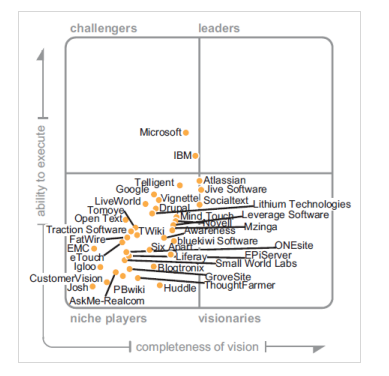
Well this certainly clears things up

Gartner Group released their Magic Quadrant for Social Software towards the end of last year and I came across it today while doing some research.  It was great to see cool company Socialtext featured in the analysis although that is a bit hard to determine when you look at the quadrant itself.  Guess it's fair to say there are no true leaders in this market yet but definitely plenty of players.  Think they could have crammed any more companies in the bottom left?

Picture 2

Free text messaging…for you

Your friends, well, they still have to pay.  New capability lets you send a text message directly from the Gmail app but… 

"Keep in mind that all these text messages count as part of your regular
mobile messaging plan and might incur fees. So unless you know your
friends have unlimited text message plans, please be sensitive to their
phone bills."


Pretty cool actually as more forms of communication are consolidated in a single application (email, IM, etc.).  I've enabled it in my Gmail and look forward to taking it for spin.

A framework for understanding personal messaging

I have been thinking through this a bit and am trying to get my head around all the ways we connect and share information (person to person).  As blogging is not only a great way to share but a way for me to sort my thoughts on topics, I thought a post would force my thinking a bit.

At this point, I have identified 10 different categories for personal messaging:

1. Email

  • Corporate (Exchange/Domino environments)
  • Webmail (free services like Gmail, Hotmail, Yahoo! mail)
  • 'Site mail' (closed network email like Facebook or LinkedIn mail)
  • Email services (outbound where you can assign a "From" like email marketing systems)

2. Text messaging

  • From a device
  • From a browser
  • From a system

3. Instant messaging

  • Stand alone apps like AIM or Trillian
  • Inside webmail like Gmail
  • Site IM (like Facebook)

4.  Content sharing/distribution (Slideshare, Youtube, etc.)
5.  Blogs (includes web pages, RSS feeds, and comments)
6.  Wikis and other collaborative spaces (closed/invitation only)
7.  Micro-blogging (Twitter including its direct message capabilities)
8.  Voice (includes POTS, VOIP, and cellular)
9.  Video (new like Gmail feature)
10. Other social networking tools/sites (a laundry list of options here including Facebook, MySpace, etc.)

I'll follow up with a post around the twelve or so factors to consider when selecting one method over the other.

Your network is the platform

As I sort through the noise of all the forms of personal communication and connection available to me these days, it occurs to me that each of these platforms (personal & work email, my cell phone, CRM applications, social network du jour (Facebook, LinkedIn,etc.)) is disconnected from the other. 

The true "platform" is my active network and the actions I take during the course of the day. 

The fact that I have to jump between applications and devices to manage it all makes it almost unbearable.  I believe the answer to this is connectivity among all these disparate tools where no one platform is superior to the other.  They all serve some purpose for me ranging from critical to curiosity and it would be nice to manage them centrally.  This would shift ownership (and control) from any one of these platform providers to the individual but isn't that the way it should be?

Hyperconnectivity

New study out from IDC points to something many of us know well – we are connected via an increasing number of devices and applications to communicate, learn, and collaborate.  Interestingly China and the US are at the top of the hyperconnected stack.  Building on a theme for today, I am sure China will continue to surge ahead as its population gains greater and greater access.  A couple of interesting quotes:

"Almost two in 10 workers in 17 industrialized countries use a minimum of seven devices for work and personal access to communication networks."

"People in this category also use at least nine applications, such as instant messaging, text messaging, Web conferencing, and social networks, analysts found."

Pick up the phone

Picking up the phone and talking to someone is my preferred way to get a point across these days.  Email is the crutch of the business world where people can communicate in a way they would never contemplate in a direct conversation.  It dominates our daily communications and has changed the way we work (not necessarily for the better) where typing has replaced talking.

Here’s a story from the NY Times (via Instapundit) on the demise of the office phone and how that is impacting both work dynamics and organizational learning.  I especially like this quote:

"That brings up another reason the office phone call is worth preserving: there’s no ready substitute for practicing the necessary summoning of courage for potentially fraught encounters. Advancing in business is often a matter of gaining capacity for confrontation; to the best of my knowledge, no one has ever had to steel herself before sitting down to type a tough e-mail message."

If you have ever made a cold call, the quote above should hit home.

In a related post, Fred Wilson does a nice summary here of the running discussion on money saving tips for start ups including this bit of advice "Don’t buy a phone system. No one will use it."  Although the advice is based on the fact everyone already has a cell phone, I’ll still give Fred credit for scooping the Times.