
Trust and Risk

This is one of those posts that has been on my mind for some time so it is not completely formed but wanted to force it down in writing to crystalize my thinking a bit.

Much of what I do now as an early stage investor revolves around trust and risk in relationships. Trust is how much you believe in someone or something – your expectations of engagement. Risk is the downside exposure (loss potential) created by that engagement.  This same framework can be applied to personal relationships although in both professional and personal situations there remains considerable gray area.

To clarify my thinking on this, I created a pretty standard 4×4 matrix laid out below (yes, I have mad design skills). The four quadrants described on the X and Y axis:

Each quadrant has a distinct relationship profile as follows:

Low Risk to High Risk (X)

Low Trust to High Trust (Y)

High Trust, Low Risk – the relationships you keep closest and depend on. This could be family, friends, business partners, counselors, etc.  Your inner circle with the most unconditional relationships.

High Trust, High Risk – this most closely parallels the relationship with early stage founders in my world. Significant risk in the relationship but a level of trust that has led to an investment of time and money. You are aware of the downside risk but have confidence in them to make decisions to navigate that risk.  This could also be applied to how LPs in funds view fund managers.

Low Trust, Low Risk – people or entities you interface with but have little to no regard or concern about. Not a priority but also limited to no downside risk from exposure.

Low Trust, High Risk – the ones to watch out for with the combination of lacking trust but can cause significant damage or loss to you.

Relationships can change over time so movement among these quadrants happens with varying levels of consequence and finality: 

High Trust to Low Trust – this is most jarring when a trusted relationship violates that trust and becomes untrustworthy. This is hard and often impossible to reverse (Low Trust to High Trust) but can happen.

High Risk to Low Risk – is more of a natural evolution in an early stage company where as the business matures, the risks that could lead to a complete loss are mitigated while less catastrophic risk remains.  Moving the opposite direction (Low Risk to High Risk) can happen frequently when assumptions, market conditions, or consequences of a decision come to light. If you invest with a “risk on” mindset, you are aware that this can be fluid with the goal of not being taken completely by surprise.

Of the movements among the quadrants, the most jarring is going from High Trust, Low Risk to Low Trust, High Risk. This can seem like betrayal or being blindsided by a behavior that was unexpected and significantly increases overall risk exposure.   Recovering a relationship from this type of dramatic change is rare.
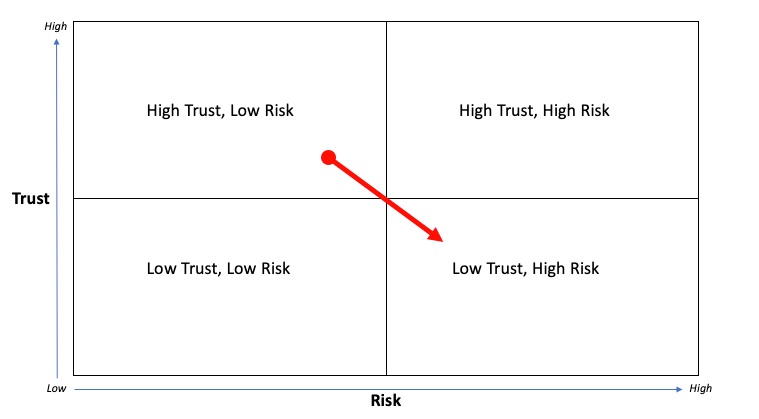
My primary lens on this post is from a professional standpoint and the initial thinking emerged from a sudden High Trust, Low Risk relationship becoming Low Trust, High Risk. I was trying to process what had occurred, how I had missed the potential and why it was bothering me so much.  

Without being overly cynical, the same framework can be applied to personal relationships to a degree. Trusted and close relationships are High Trust, Low Risk. Things and people that just don’t matter are Low Trust, Low Risk. The things and people to be wary of are focused on Low Trust, High Risk while you should be eyes wide open on anything or anyone fitting the High Trust, High Risk quadrant.

Thanks for coming to my TED talk….

Ok, got that out of my head and will most likely edit and revise this going forward so stay tuned for that.

Photo credit from Flickr

Cross posted on Linkedin

Why I write things down

  Moleskine

It does seem a bit peculiar to write a blog post about the reasons I still put pen to paper but as the number of electronic gadgets explodes and we spend more of our waking hours with our noses stuck in smart phones and iPads, I thought explaining why there is still a place for writing things down in my world seemed appropriate.

I have always carried a paper pad of some kind (steno, legal, etc.) around with me to take down notes or lay out my thinking on a topic or problem.  For years, I used a leather portfolio given to me when I graduated from college.  It is black, fits a legal pad, and has a pocket for papers – simple, but effective.

Always on the quest to learn new things by reading other's blogs, I saw a post from someone about using a Moleskine notebook to capture thoughts.  Paper and portable, I thought, count me in.

The Moleskine has a distinguished history hailing from Milan and used by the likes of Picasso, Hemingway, and Matisse.  More on the history here including its demise in 1986 and rebirth in 1997.  I capture nothing as distinguished but do find reviewing previous entries pretty fascinating and like the way it fits in my back pocket.

I was in Chicago last week meeting with some great folks ahead of an event and took out my Moleskine to jot down a name and phone number.  From the other side of the table, I heard "Don't you work for a technology company?"  This was all in good fun and I replied "Why yes, I do, but this is my secure and portable note taking application.  Instantly searchable (thumb pages) and encrypted because my handwriting can become undecipherable even by me."

We all laughed at the situation but it stuck with me and is the inspiration for this blog post.

I write things down because I want to remember them, reference them, and demonstrate to the other person that it is important enough to capture by hand.  A phone number, a name, a place, or a random thought…it doesn't matter.  I find it much easier to jot down a quick note when an idea comes to me or I am trying to organize tasks.  

This is part of my workstyle and I'm not saying it is for everyone or that a Moleskine is the key but it is how I capture important thoughts, detail follow up items, and organize my activities.

A year off every seven years?

Sounds like a good plan to me. 

Listen to what Stefan Sagmeister has to say about the power of time off and think about how you'd pull this off.  This is about taking a few less years of retirement and living a little more during your working years.

Thanks to the folks from the TED conference for sharing this and for Stefan for making us think about it.  This event is definitely on my list to work my way into at some point.

Meeting new people

I suppose you either like to do this or not.  I believe we all can carry and support 10-20 really close personal relationships with the balance being casual/professional acquaintances.  Beyond these casual/professional acquaintances are those with whom we would like to build a relationship.  Someone we admire, someone we are trying to sell to, or generally seeking some benefit from having a relationship.

I have always been interested in meeting new people and the older I get the more this interests me.  I have overcome whatever shyness I had a long time ago as I realized that being proactive and tenacious will create more opportunities plus you will always learn something from these encounters. 

Asking for someone's time is a bit intrusive.  After all, I am asking for something that you have a finite amount of and unless you too are interested in meeting new people for the sake of it, then you see these opportunities as a waste of time.

"Networking" is a overused word and you don't just start contacting people when you need something.  My goal is to always ask what I can do for the person with whom I am meeting and try to make these meetings part of my regular schedule.  One great benefit of blogging is meeting new people be it through a comment, an email, or a face to face.  Believe it or not, the more you do for others, the more will be done for you.

I am sharing all of this as I was recently rebuffed after asking for someone's time.  I did so at the recommendation of a friend and without a clear agenda or "ask" in mind because I really didn't have either.  Yes, you can fault me for that as it is different than my approach to formal meetings but this was not a formal meeting request. 

Twenty minutes to shake hands, put a face with a name, and add someone new to my professional acquaintance list was my goal and I believed this person was open to these types of connections.

Clearly, he was not.  As I thought more about it and reflected on the lengthy response to my inquiry (which actually probably took more than 20 minutes to write) which laid out his frustration and, quite frankly, resentment of being approached without a specific reason relevant to him, it became clear that either he didn't like to meet new people or his interest in such meetings had been tapped out long ago. 

From my perspective, 20 minutes is not a great deal of time in the big picture and you never know where a new relationship will lead but keep in mind this perspective must be shared by the person from whom you are requesting time

You are only as smart as your questions

I’ve got hiring and interviewing on the mind as this business week comes to an end and found a great post via Boulder, CO blogger Bill Flagg.  I don’t know Bill and came across his blog via my on going affection from afar for the Boulder tech scene.  Marel and I often talk about making it our home at some point and maybe one of these days the stars will align.

Anyway, the post is about "the smartest interview question" and I thought this was a great point:

"You are only as smart as your questions and as dumb as your answers. The more I shut up and ask questions, the smarter I get. The more I spout off, the less time there is to learn from what other people have to say."

Hiring the right people can make or break a start up or early stage company.  Make sure you find those that want to help you build and know what that means.