My intro to David Allen & GTD

I had the chance to hear David Allen speak yesterday at a luncheon put on by the Seattle Chamber of Commerce.  This was both my first Chamber event here in Seattle as well as my first real introduction to David Allen and his "Getting Things Done (GTD)" approach to life. 

Yes, this fits into the 7 habits, personal productivity, etc. category and you could listen to what he says and think to yourself you knew all this already.  Fair enough, but we all benefit from a 3rd party weighing in on the habits (good and bad) that we have developed and thinking about (not obsessing about) our current approach to productivity.

A few things struck me during his presentation that I'll share in a few follow up posts including the 2 minute rule for email.  If you can resolve it in two minutes or less, do it when you read it.  Any longer than that and prioritize it accordingly.

I thought he was a great speaker as he entertained but methodically walked through his approach and some things to think about.  I also received a copy of his new book Making It All Work: Winning at the Game of Work and Business of Life
along with my lunch.  All in all, time well spent.

Busch League

I have used this phrase for many years to describe things that are half-baked or amateur in nature.  For the sake of posterity, I thought I'd do a post on it and share with all of you this handy phrase which you can feel free to use liberally.

Urban dictionary defines it nicely and points to another one of my favorite phrases to help define it – 'Amateur Hour.'  At the risk of incurring the wrath of auto racing fans, it also describes the minor league baseball of racing.  NASCAR is the show while the Busch Series was (it appears to now be sponsored by Nationwide – I don't keep up) the next level down.

My point is to know what you know, know what you don't know, and don't pretend you know everything.  If you do, this label or one like it will find you eventually.

Measuring Your Viral Coefficient

I was told there would be no math. 

Contrary to the title of this post, this is not about math per se.  It is about a way to think about how a product is consumed and advocated by your customers.  For the math on this, check out this post from Robert Zubek.

Essentially this is a measure of how "viral" your product is by measuring how many additional users you acquire from each subsequent user.  You have done very little to acquire these customers other than create a great experience for the initial user and have a great product.  Get it?

On-demand/SaaS delivery models allow people to access products and information about those products and the problems they solve at will with a browser and internet connection. 

You can build product functionality to facilitate this with "share this" or "refer a friend" capabilities and, of course, ask your customers to bring you new customers as 'word of mouth' is the holy grail in a modern marketing plan.  It is hard to create this artificially but is amazing to watch when it happens organically.  One of the companies I am working with is seeing this happen and it is really fascinating to watch.

I also like this post by Josh Kopelman on what to do "After the TechCrunch Bump."  The herd that follows posts on sites like this are not target users finding value in your product that they want to share with others.  They are more akin to wildebeests following the lead animal across the plains of the Serengeti making a huge amount of noise, gone before they got there, and leaving behind a great deal of destruction and waste.

The Time is Now

I've not had the chance to meet David Cohen (yet) but am a fan of his blog ColoradoStartups

You should read his "Plenty of time for that later" post from which I am going to lift a passage to share here:

"So, if you’re thinking about doing a startup that you’re really
jazzed about, and are trying to decide if now or later is the time,
here’s my advice. Look at the clock on your computer, and make a note
of the current time and date. Hang that note on your desk or on a wall
somewhere where you will see it every day. Now, ask yourself if you
want to watch the days, weeks, months, and years slip by while your
dream just hangs there on the wall or if you want to do something about
it.

If you passionately want to do something about something, now is the time. Later is just an excuse."

Great words David.

I'll be in Boulder later this month and maybe will actually be able to meet David in person during my visit.

Pessimism

I got a healthy dose of this today in a meeting and thought the experience worthy of sharing.  No doubt things are not as good as they have been although that "good" period is suspect based on the leverage and borrowing that was at play.

It is true that growth will revert to the mean over time..it always does.  That means sluggish growth or even contraction in the short term.  I do not, however, believe that it is the end of times.

I find it hugely annoying when people make broad-based generalizations in an attempt to project expertise about a subject without real expertise or supporting data.  These people follow the herd vs. lead so maybe this in itself is a sign of good things to come.

Orchestria acquired by CA

Congrats to the team at Orchestria on being acquired by CA.  I haven't heard terms or amount, but hope it was somewhat positive for the investors and team. 

I both worked for and competed against Orchestria and made some good friends and had some great experiences along the way.  I think about my time there as a perfect example of going through the process of finding product/market fit. 

When I started there in 2002 we had a really cool product that could do many things around messaging and desktop control.  The process of taking it to market and finding a fit around compliance, broker/dealers, and supervision was really exciting (and a bit painful).  After my departure, they made a turn into the data loss prevention market and that appears to be the story being told about this acquisition.

Also, the Ferris Research blog has a bit of commentary including speculation on deal terms.

Blogging by the book

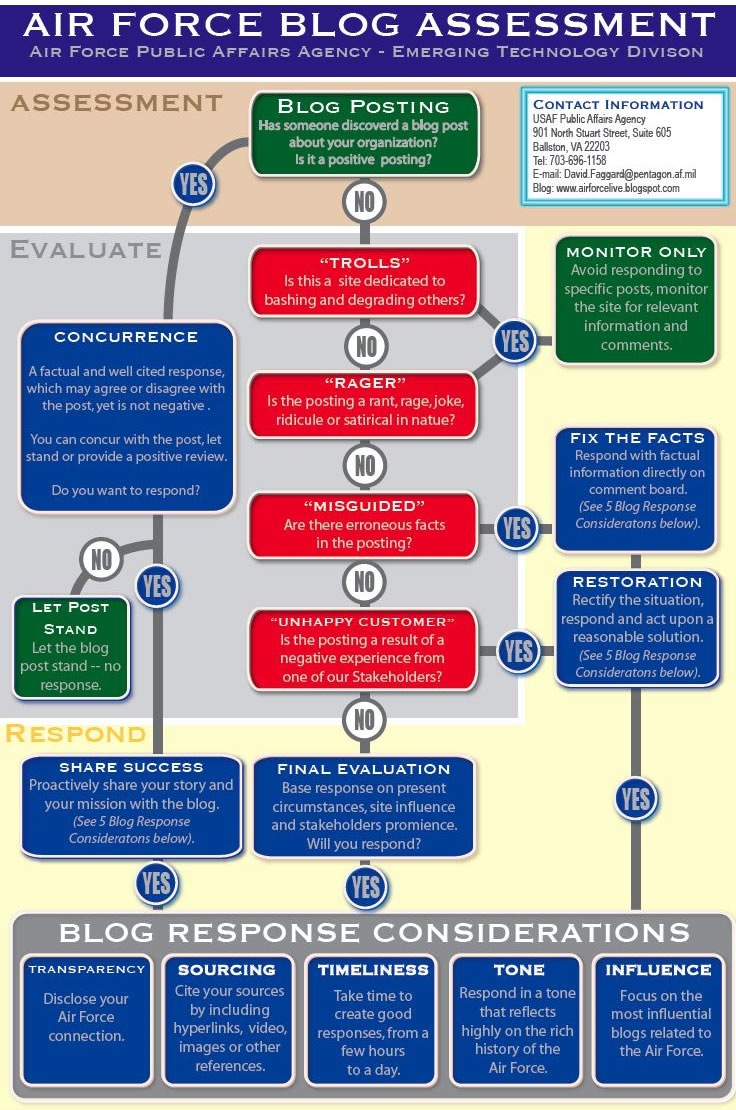
Looking to learn how to incorporate blogs into a communications plan?  Want to understand a best practice approach to responding to blog postings and comments both good and bad?  Seeking ways to feel good about your tax dollars spent on defense?  Look no further than this really nicely done graphic brought to you by the US Air Force (via Jeremiah Owyang of Forrester Research). 

Air-force-blog-assessment

Success unexpected in 2009

Rather than do a post on predictions for the new year or one on resolutions that I will do my best to keep but mostly break, I thought I would share a key theme instead.  I believe these wise words will get us all off to a great start in 2009:

"I learned this, at least, by my experiment; that if one advances confidently in the direction of his dreams and endeavors to live the life which he has imagined, he will meet with success unexpected in common hours."

Henry David Thoreau
Walden, "Conclusion"

Happy New Year!

Happy New Year everyone.  Be safe and festive tonight. 

We are sticking to Kirkland this year for our celebration and look forward to seeing the fireworks at the Space Needle from the deck.  Let's hope there is no malfunction this year.

I'm looking forward to a great 2009!

A Lesson in Hype & Unrealistic Expectations

My other option for the title of this post was 'Why Cuil Failed' but I didn't want to clutter the title with a phonetic explanation: Cuil = cool.  Or not.  

If you don't know what Cuil is, no worries, as they are now on a deathwatch.  There is, however, a lesson to be learned from their grand adventure.

They launched to much excitement that they were a better search than Google and even a "Google killer."  A big claim…and big story.  A true threat set to unseat the king of search and with the brains on board to do it.  The only problem?  It didn't work well enough.  It didn't measure up to the hype.

"This was entirely the company’s own fault. It pre-briefed every blogger
and tech journalist on the planet, but didn’t allow anyone to actually
test the search engine before the launch."

It is always important to sell a vision but you must have the ability to back it up to some degree.  There is plenty of time to sing the praises of how much better or innovative you are than the other guy once you actually have the customers and experience to prove it.

The backlash comes quickly and severely in a connected world especially since technology products and services are becoming more consumable leaving users to try them and form opinions outside the span of marketing's control.

Cuil peaked before it was able to deliver leaving any incremental improvement to be seen as correcting a problem versus delivering a new capability. 

Anyway, at this point it isn't really about better search.  Google didn't create search, they wrapped a business model around it.